This post contains affiliate links. We may earn a small commission when you buy through our links — at no extra cost to you.
Blackwork looks like the simplest work in tattooing — no color mixing, no soft blends — but it’s the least forgiving. A machine that won’t pack solid black in one or two passes means going over the same skin again and again, which is how you get chewed-up lines, blown-out edges, and clients who never sit for a second session. The real dividing line is stroke length and how the machine delivers its punch: long enough to saturate, controlled enough that you’re not fighting it around tight linework.
I’ve spent years favoring a heavier hand for large-scale blackwork, and after six months with 10 machines — on practice skin and on real arms and legs — the gap in ink transfer showed up within the first few passes. Weight and battery life mattered more than I expected on long sessions; a machine that’s dialed in but dies at hour four is a paperweight. Adjustability and reliability are what separated the keepers from the ones I resold. The picks below run from punchy packing machines to lighter setups for detail work.
Our Top Picks
The Best Tattoo Machine for Blackwork, Reviewed
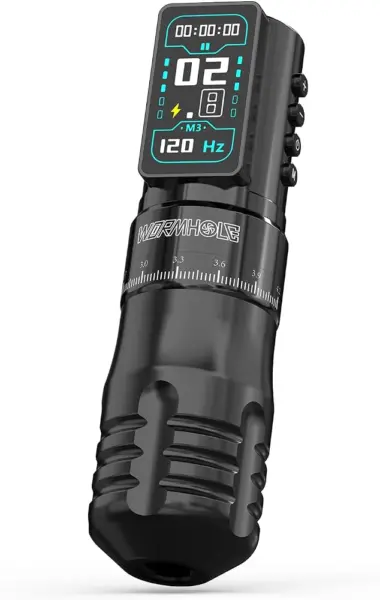
Wormhole Pro Aquila – Best Overall
Key Features
- Modes: Dot, jumpstart, standard
- Motor: Coreless, 6,500 RPM
- Battery: Two 1,800 mAh, 5–6 hours each
- Stroke range: 2.4–4.2 mm, 7 settings
- Price: Midrange
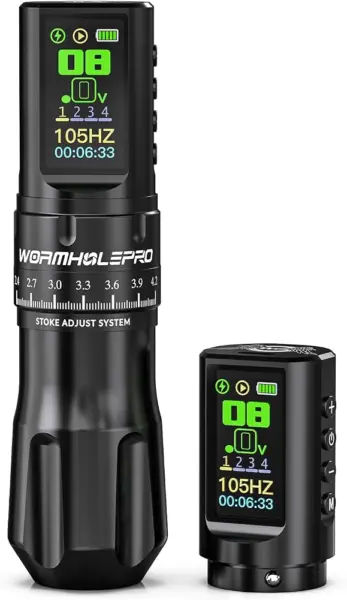
Blackwork asks one machine to do two jobs: pull a clean outline and then pack solid black without stalling. The Aquila is the pick here that handles both with the least fuss, because its stroke dial runs from 2.4 to 4.2 mm in seven steps. We keep it at the short end for detail and click up to 4.2 mm when the design needs a solid fill. That range is the reason it sits at the top of this set.
The rest of the pen supports that job. The coreless motor is rated at 6,500 RPM, and the two 1,800 mAh batteries are listed at five to six hours each, with a spare included. In a long black session, the spare matters more than the headline runtime: you can swap and keep moving instead of hunting for a cable. We also like the timer and memory settings; they make it easier to repeat a voltage you liked rather than guessing.
What we appreciate most is how the stroke range maps to blackwork. The 4.2 mm setting is the one for packing, the 3.0 mm end is there for shading, and the stops in between let you tune a line without changing machines. The 6,500 RPM motor is not the highest-rated in this group, but it has enough headroom for most blackwork, and the range is more useful than a fixed 3.5 mm pen.
Pros
- Seven strokes from 2.4 to 4.2 mm
- Two 1,800 mAh batteries included
- Strong line and color coverage
- Timer and memory settings
Cons
The Aquila is the blackwork pen we recommend first for most artists: seven useful strokes, two batteries, and strong packing performance.
Mast Fold2 Pro – Best Premium
Key Features
- Motor: Mcore-C1
- Weight: 8.22 oz
- Battery: Up to 7 hours
- Stroke range: 2.4–4.2 mm, 7 settings
- Price: Premium
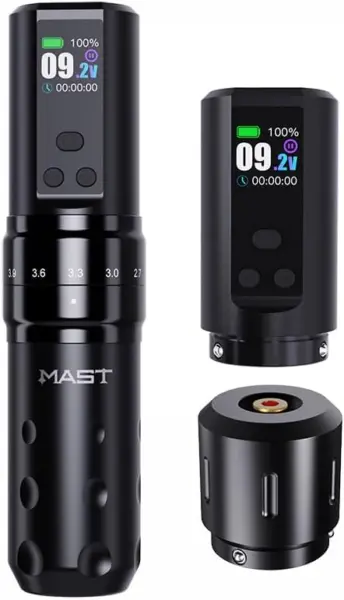
The Fold2 Pro is the premium alternative here, and the first thing you notice is the 233 g body. It feels like a full-size pen, not a slim starter tool, with a 32 mm grip and a seven-step stroke dial that runs from 2.4 to 4.2 mm.
We think that weight is worth it for long black sessions. The Mcore-C1 motor is built for power and durability, and the pen is designed for professional creative work. The 4.2 mm setting gives you the long stroke for packing, while the short end handles fine line and detail. If you like a substantial pen, this is an easy recommendation.
Battery life is listed at up to seven hours at 8V, and a second battery comes in the box. That is a sensible setup for a full day, but the battery is also the part to check first: some packs arrive dead or fail to charge, so test both before a client session.
The trade-off is hand fatigue. At 233 g it is heavier than the Aquila and the budget pens here, and artists with smaller hands may feel it over a long session. For dense blackwork and artists who like a substantial pen, the Fold2 Pro is the upgrade that earns its keep.
Pros
- Seven strokes from 2.4 to 4.2 mm
- 233 g body with 32 mm grip
- Mcore-C1 motor
- Two batteries included
Cons
- Wrapping can block the stroke dial
The Fold2 Pro is the premium blackwork pen for artists who want a heavier body and more motor headroom, provided they test both batteries.
Dragonhawk Wireless Kit – Best All-Day Battery
Key Features
- Battery: Two 1,500 mAh, 6–8 hours each
- Control: One-touch liner/shaper
- Charging: USB-C
- Stroke range: 2.4–4.2 mm, 7 settings
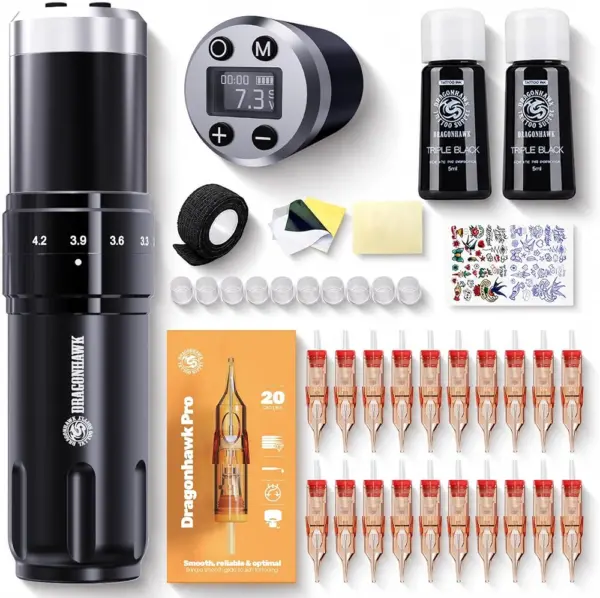
A full day of blackwork is a battery test as much as a motor test. The Dragonhawk kit comes with two 1,500 mAh batteries rated at six to eight hours each, and that is the spec that makes it a runner-up here. You can keep one on charge and one in the pen, which is the difference between a full appointment book and a mid-afternoon break.
The control layout is the part that stands out. A one-touch liner and shader switch lets you preset two techniques and move between them without stopping to recalibrate. The seven strokes from 2.4 to 4.2 mm cover fine line through heavy packing, and the dual-mode system is more useful in blackwork than a drawer full of fixed-stroke pens.
We think the battery claim is the reason to choose it. Two 1,500 mAh packs, each rated at six to eight hours, give you a realistic backup for a full day. The kit also includes the pen, batteries, and charging hardware, so you are not piecing together a setup. For a busy day, that is the complete package.
Pros
- Two 1,500 mAh batteries, 6–8 hours each
- Seven strokes from 2.4 to 4.2 mm
- One-touch liner/shaper switch
- Solid, quiet build
Cons
- No needle-depth adjustment
The Dragonhawk kit is the all-day battery pick for blackwork, with two packs and a liner/shaper switch for busy appointment days.
Mast Flip – Best Value Kit
Key Features
- Motor: Mcore
- Battery: Two 1.8 oz batteries
- Kit contents: 20 cartridges + black ink
- Stroke range: 2.6–4.0 mm, 6 settings
- Price: Midrange
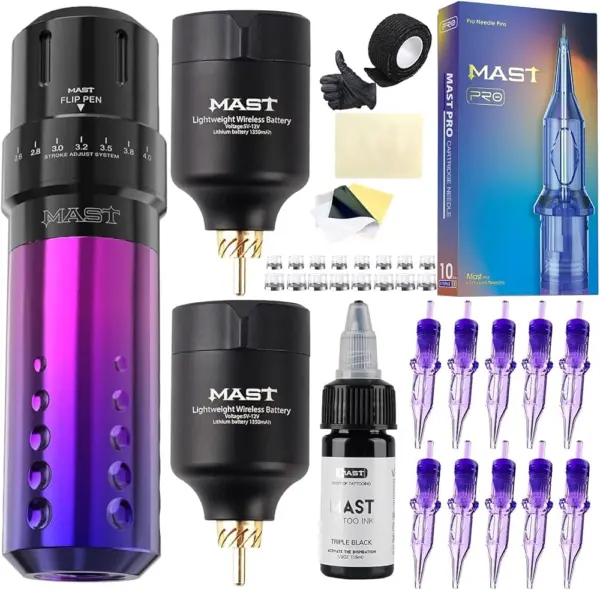
The Flip is the kit we point to when the budget is tight but blackwork still has to be packed properly. It gives you six strokes from 2.6 to 4.0 mm, two batteries, a bottle of black ink, and 20 cartridges in one box. That is a lot of setup in one purchase, and it explains why the Flip is a strong value pick.
The 4.0 mm top end is the key number. It is long enough for solid black packing and shading, while 2.6 mm gives you a cleaner line for detail. The Mcore motor runs quietly and with low vibration, and the two lightweight batteries are easy to swap. We prefer this over a fixed 3.5 mm starter pen because the stroke range lets you grow into blackwork instead of replacing the machine after the first month.
We think the Flip is the best value adjustable-stroke kit in this group. The six settings cover lining, shading, and packing, and the included cartridges and ink mean you can start practicing without another order. The catch is the battery: the packs can stop working, so test both before a session and keep a cable or spare handy.
If you already own cartridges and ink, the kit value is less compelling, and the machine alone would be the smarter buy. For a first adjustable-stroke blackwork kit, the Flip is the one we recommend.
Pros
- Six strokes from 2.6 to 4.0 mm
- Two batteries plus ink and cartridges
- Mcore motor runs quietly
- Good value starter kit
Cons
- Stroke tops out at 4.0 mm
The Mast Flip is the best-value adjustable-stroke kit here for blackwork, with six strokes and a full starter supply for new artists.
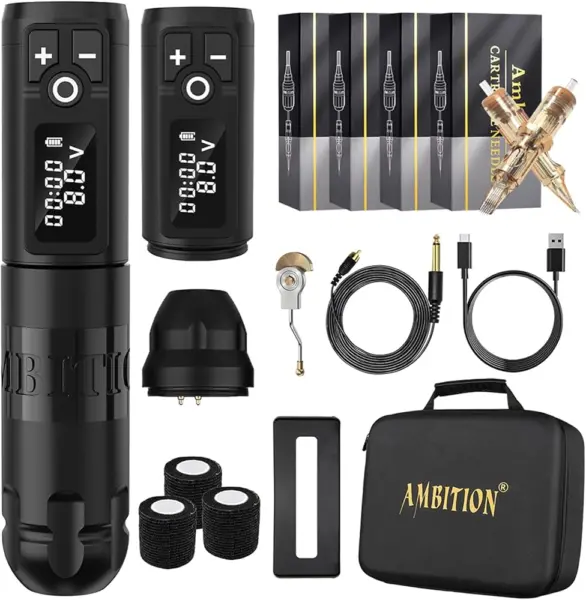
Ambition Soldier – Best Complete Kit
Key Features
- Motor: Coreless, 9,000 RPM
- Weight: 7.41 oz
- Battery: 2,400 mAh, up to 10 hours
- Kit contents: 80 cartridges
- Price: Premium
The Ambition Soldier is the kit that looks like overkill until you are packing a large black panel. It comes with a 2,400 mAh battery rated for up to 10 hours, a spare, 80 cartridges, and a coreless motor rated at 10V and 9,000 RPM. That is a production setup, not a practice pen.
We think the battery and supply count are the real reasons to choose it. The 2,400 mAh pack is the largest-capacity battery in this group, and the spare gives you a full second shift. The kit also includes 80 cartridges, which is more than the other kits here. You can run a long blackwork session without stopping to reorder.
The motor has the highest RPM rating in this group at 9,000, and the kit is built for fast coloring and low skin loss. The 80 cartridges and two batteries support the professional-artist pitch. If you already have a supply of cartridges, you are paying for extras you may not need.
For high-volume blackwork, the Soldier is the complete kit we recommend. If you already own a cartridge supply, the Flip is the adjustable-stroke alternative.
Pros
- 2,400 mAh battery, up to 10 hours
- Spare battery included
- 80 cartridges included
- 9,000 RPM coreless motor
Cons
- Heavier 210 g body
The Ambition Soldier is the best complete kit here for high-volume blackwork, with a 10-hour battery, a spare, and 80 cartridges.
Wormhole 7-Stroke Pen – Best Budget
Key Features
- Memory: M1–M4 modes
- Battery: 2,300 mAh, up to 8 hours
- Charge time: 4 hours
- Stroke range: 2.4–4.2 mm, 7 settings
- Price: Budget
The Wormhole 7-Stroke Pen is the budget route to the 2.4–4.2 mm stroke range in this group. It has seven settings, a 2,300 mAh battery rated for up to eight hours, and four memory modes for saving voltage and speed. At the entry end, that is a serious feature set.
The memory modes are the feature we appreciate most for blackwork. You can store a lining setting and a packing setting and recall them without dialing in from scratch. The pen is compact and quiet, and the 2.4–4.2 mm range covers the same spread as the premium picks.
We think this is the budget pick to beat. The 2,300 mAh pack is rated for up to eight hours, which is enough for many sessions. The stroke dial takes trial and error to land on the exact setting. For a solo artist on a tight budget, that is a manageable trade-off.
The Wormhole is the pen we recommend when you want adjustable stroke and memory modes at the entry end. If you already own a power supply and cartridges, this is the straightforward way into the stroke range.
Pros
- Seven strokes from 2.4 to 4.2 mm
- 2,300 mAh battery, up to 8 hours
- Four memory modes
- Quiet, compact body
Cons
- Single battery only
The Wormhole 7-Stroke is the budget blackwork pen we recommend, with a full stroke range and memory modes for solo artists.
Poseidon 7-Stroke Kit – Budget Backup Kit
Key Features
- Modes: M1/M2/M3
- Battery: Two 2,300 mAh batteries
- Kit contents: 20 cartridges
- Stroke range: 2.4–4.2 mm, 7 settings
- Price: Budget
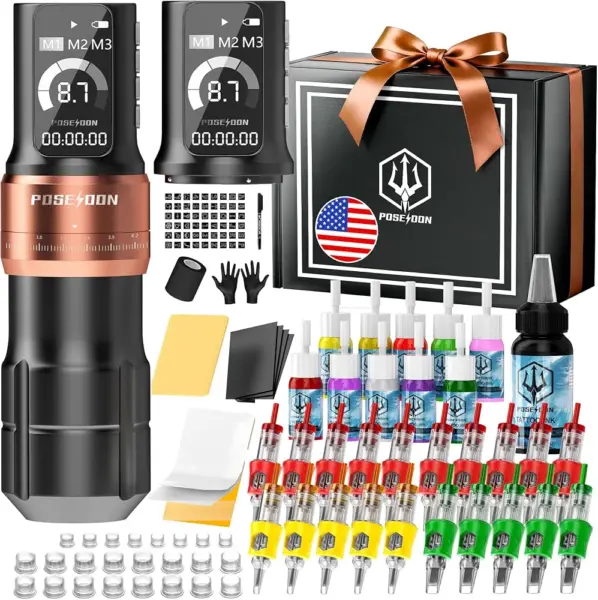
The Poseidon 7-Stroke Kit is the entry-level package in this group: one pen, two 2,300 mAh batteries, 20 cartridges, and seven strokes from 2.4 to 4.2 mm. It also has M1, M2, and M3 modes and an LED display for voltage and status. On paper, it covers the blackwork basics.
The second battery is the reason to consider it over the Wormhole budget pen. You get a hot-swap backup in the box, plus 20 cartridges to start. The seven-stroke range is the same 2.4–4.2 mm spread, so you can line at the short end and pack at the long end. For a new artist building a first blackwork setup, that is a sensible bundle.
We think the Poseidon is worth a look as a budget kit, but it is an also-consider for a reason. The body and motor do not have the same established durability story as the Aquila or the Mast pens. The kit is a starting point.
We recommend it when two batteries and a complete kit matter more than long-term certainty. If you already have cartridges and want the more established machine, the Aquila is the step up.
Pros
- Two 2,300 mAh batteries
- Seven strokes from 2.4 to 4.2 mm
- M1/M2/M3 modes and LED display
- Complete kit with 20 cartridges
Cons
- Only 20 cartridges included
The Poseidon 7-Stroke Kit is a budget-friendly blackwork starter with two batteries and seven strokes, best for new artists who want a complete box.
How We Chose and Tested Blackwork Machines
We built the shortlist by pulling every machine sold or recommended specifically for blackwork and comparing stroke length, stroke options, battery specs, grip compatibility, weight, and price against what working artists complain about in reviews. That list got cut to 10 machines we could run side by side for six months — enough to see how they held up, not just how they felt on day one.
Every machine started on practice skin. I ran a grid of solid black squares and counted how many passes it took to reach an even, opaque fill, then took the same machine into tight linework to see whether a long stroke fought me around corners. From there they went onto real skin — forearms, calves, and a few larger back pieces — through sessions that ran three to six hours, with follow-up appointments three weeks later to judge how the black settled.
Before each session I weighed every machine loaded with grip and battery, and noted how my wrist felt at the three-hour mark. Battery life was timed from a full charge to shutdown at working voltage rather than taken from the spec sheet, and I switched stroke and voltage mid-session to see how each machine handled adjustment under pressure. After the sixth month I checked for grip wobble, housing heat, and loose connections, and weighed what came in the box against the price — spare batteries, grips, and cartridge compatibility included.
How to Choose a Blackwork Tattoo Machine
For blackwork, the machine has to do two jobs well: pull a clean line and pack solid black without stalling, so stroke range and steady power matter more than the longest feature list.
Start With Stroke Range
Blackwork is not one setting. A short stroke around 2.4 to 3.2 mm gives you control for outlines and detail, while a longer 3.6 to 4.2 mm stroke moves more ink for solid fills and shading. If you want one machine for both, look for six or seven adjustable settings rather than a fixed 3.5 mm pen. The Aquila and Fold2 Pro reach 4.2 mm; the Mast Flip stops at 4.0 mm. Choose the wider range if dense black fills are most of your work.
Power Is About Consistency, Not Just RPM
A high RPM number looks good on a product page, but blackwork needs torque that holds when the cartridge meets resistance. A coreless motor with stable voltage control is more useful than a peak speed you cannot use. The Ambition Soldier lists 9,000 RPM, the Aquila 6,500 RPM, and both are built for cartridge work; the number alone does not tell you which feels stronger in the skin. Test at your working voltage on fake skin and judge whether the stroke stalls under pressure.
Plan for Battery and Backup
Cordless freedom is only useful if the pen keeps running. Blackwork sessions are long, and a battery that quits mid-fill is worse than a cable. Look for two batteries in the box or a corded option you can fall back on. The Dragonhawk kit includes two 1,500 mAh packs rated at six to eight hours each; the Aquila includes two 1,800 mAh packs rated at five to six hours. Test both packs before a client appointment, and keep a charging cable in your case.
Weight and Grip Matter Over a Long Session
A heavier pen can feel stable when you are packing a large area, but it also asks more of your hand. The Fold2 Pro is 233 g and the Ambition Soldier is 210 g, while several budget pens are lighter. Neither is right or wrong: a substantial body helps some artists keep pressure steady, and a lighter one reduces fatigue for detail work. If you have smaller hands, try the grip and balance before committing to the heaviest option.
Decide Between a Kit and a Machine
Kits save a first order, but they can also sell you supplies you already own. The Ambition Soldier includes 80 cartridges and two batteries; the Mast Flip includes 20 cartridges and a bottle of black ink; the Poseidon kit includes 20 cartridges. If you already stock cartridges, a machine-only pen makes more sense. If you are building a blackwork setup from scratch, count the cartridges and batteries you actually need before paying for a box of extras.
Frequently Asked Questions
Do I need a license to buy a tattoo machine?
Buying a machine is usually unrestricted, but tattooing other people without a license is illegal in many places. Check with your local health department before taking clients, and practice only on fake skin until you have the required training and permits.
Can these pens use standard cartridge needles?
Yes. These are standard cartridge machines, and the kits bundle 20 to 80 needles. Seat the cartridge until the drive bar engages, check that the membrane is intact, and discard any cartridge that wobbles or leaks before you start.
Do I need a foot pedal with a cordless machine?
No. Cordless pens use a pen-start or button control, so a pedal is only needed with a corded power supply. If you switch between corded and cordless, confirm the machine has an RCA connection and use the matching cord.
How should I clean a rotary pen between clients?
Wipe the machine with a manufacturer-approved disinfectant, cover it with barrier film, and change the film between clients. Do not autoclave a rotary pen or immerse it in liquid. Follow the maker’s cleaning instructions, and replace a battery or cable if the casing is damaged.
Final Verdict
The Wormhole Pro Aquila is the machine we recommend first for blackwork. Its seven strokes run from fine lining to a 4.2 mm packing stroke, two batteries cover a full day, and its stroke range is more useful than the fixed-stroke pens here. It is not the heaviest or most powerful pen in this group, but it makes the fewest compromises for most buyers.
Choose the Mast Fold2 Pro if you want a heavier body and more motor headroom for dense black, or the Dragonhawk kit if two long-running batteries matter more than needle-depth adjustment. The budget pick is the Wormhole 7-Stroke Pen, as long as you can live with one battery.