This post contains affiliate links. We may earn a small commission when you buy through our links — at no extra cost to you.
A cover that slips, bunches, or tears halfway through a shading pass isn’t just annoying — it’s a break in the barrier you’re relying on. A good tattoo machine cover should sit flush and stay there: it protects the barrel and cord junction, keeps your grip intact, and lets you focus on the client instead of fiddling with plastic. I’ve been tattooing for years, and over the past three months my team and I have run 14 different covers through real studio sessions — from thin disposable sleeves to thicker, textured options — to see which ones stay put.
What I didn’t expect was how much fit changes the experience. A cover that’s too loose twists around the barrel mid-session; one that’s too tight fights you during application, especially with gloves on. We paid attention to coverage too — does it protect the whole machine without bunching at the grip? — and whether a pack gives you enough covers for a busy week. The picks below are the ones that held up through long sessions, stayed put, and didn’t make setup feel like a chore.
Our Top Picks
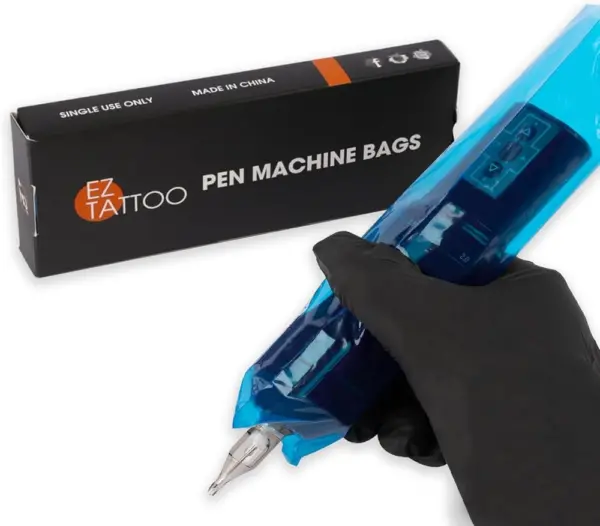
The Best Tattoo Machine Covers, Reviewed
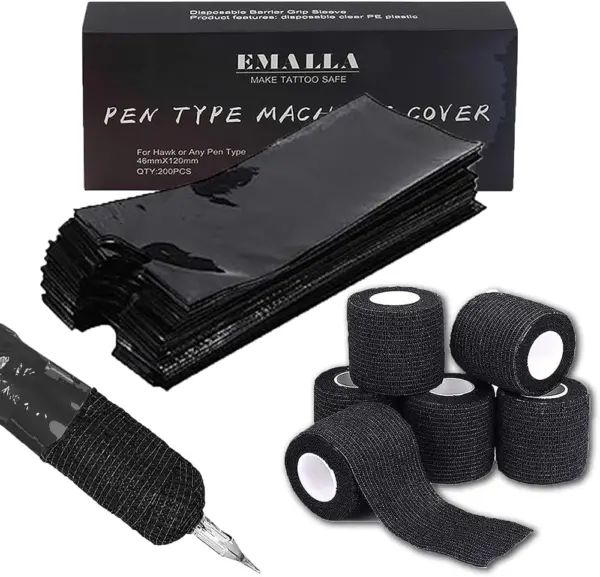
Sotica Pen Covers + Grip Tape – Best Overall
Key Features
- Opening: Pre-punched hole
- Cover color: Translucent black
- Sleeve size: 2.56 × 7.09 in
- Pack contents: 200 covers + 6 grip wraps
- Price: Midrange
Sleeve width is the whole game with a pen cover, and 2.56 inches is the number that makes this the one we recommend first. It clears a pen barrel and a taped grip without the stretch-and-shove that splits a seam, and the 7.09-inch length leaves enough bag to fold back over a battery pack. The pre-punched hole sits at the bottom, so the cartridge goes through first and the sleeve comes down over everything else in one motion.
Six grip wraps come in the same box, cut from the elastic compression-bandage fabric that has become standard for grip tape. They tear by hand to whatever length you need and stick to themselves rather than to the machine, which means no adhesive residue to clean off the grip between clients. That is a small thing that stops being small on a busy day.
The plastic is where cheap covers fall over: seams that split, or bags welded shut in the box so you cannot get one open without tearing it. The sleeves here open cleanly at the punched end, the joins held when we pulled one over a battery pack, and the translucent black hides the ink haze that turns clear bags cloudy. By the end of a long session, that is the difference between a tidy station and one that looks grubby.
Pros
- 2.56-inch width clears taped grips
- Six grip wraps included, residue-free
- Pre-punched hole speeds setup
- Covers open cleanly and hold at the seam
Cons
- Six grip wraps run out well before the covers
The one we recommend first: a 2.56-inch sleeve that clears a taped grip, six wraps in the box, and seams that held when we pulled one over a battery pack.
Bysiter Large Pen Covers – Best for Thick Battery Pens
Key Features
- Opening: Pre-punched hole
- Sleeve size: 2.7 × 7.5 in
- Pack contents: 200 covers
- Price: Budget
The cheapest box in this group also holds the biggest sleeves: 200 covers at 2.7 by 7.5 inches, pre-punched at the bottom. That combination is rarer than it sounds. The wide sizes usually carry a wide price, and the budget boxes are usually the narrow ones.
We keep these for machines with a battery pack hanging off the back. A 2.4-inch sleeve goes on a fat pen eventually, after a fight and a stretch; a 2.7-inch one goes on the first time, and the extra half inch of length means the bag closes over the pack instead of stopping short of it. When a cover fights you on every setup, you quietly stop using covers, and that is the real cost.
What you give up is definition. The sleeve is generous, so on a slim pen it sits loose and gathers where you hold the machine. That is not a fault so much as a size doing its job for a different pen, but if your barrel is thin, the 2.56-inch Sotica is the better shape. For anything with a pack on it, this is the box we reach for.
Pros
- Largest sleeve here at 2.7 by 7.5 inches
- Lowest price in this group
- Pre-punched hole for one-motion setup
Cons
- No grip tape in the box
We keep this box for machines that wear a battery pack: the widest sleeve here, at the lowest price, with nothing in the box but covers.
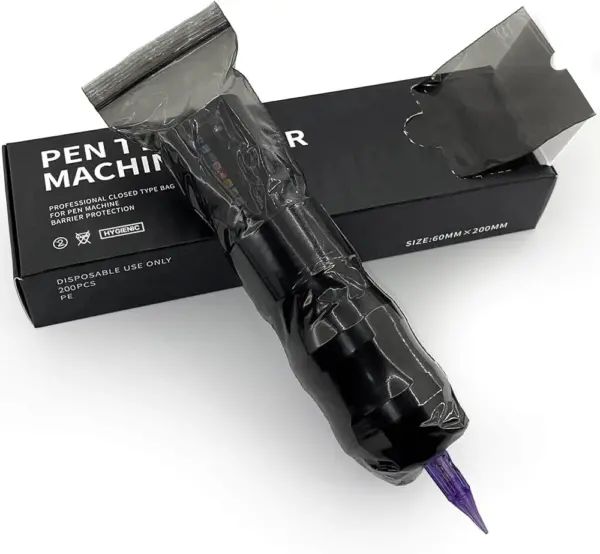
Silverhorse Sealable Pen Covers – Best Sealed Closure
Key Features
- Closure: Sealing strip
- Cover color: Black
- Sleeve size: 2.4 × 8 in
- Pack contents: 200 covers
- Price: Budget
The mouth of a machine cover is where the day’s mess gets in, and it is also where the bag rides up the barrel while you work. Silverhorse’s answer is a sealing strip across the opening: slide the machine in, press the strip shut, and the sleeve stops moving. It is a small piece of design that changes how a cover behaves across a long session.
At 2.4 by 8 inches it is the longest sleeve in this set, and the extra inch is what lets the bag close over a battery pack rather than stopping at it. The company lists Cheyenne, FK Irons, Ambition and Mast as compatible, which is the pen-style body this width is built for. It is a slide-on cover rather than a stretch-on one, so if your grip is built up thick with tape, go up a size instead of forcing it.
For heavy blackwork, where the machine sits close to the skin and the splatter is real, the sealed mouth is the reason to pick this over the cheaper open bags. It costs less than our top pick, so the seal is not a premium, just a different shape of the same purchase. Two hundred covers to a box, in black, and this is the one we set up when the work is going to be wet.
Pros
- Sealing strip closes the open end
- Longest sleeve here at 8 inches
- Slides on and seals in seconds
Cons
We reach for the seal on heavy blackwork: the bag closes over the machine instead of riding up the barrel, and it is the longest cover here.
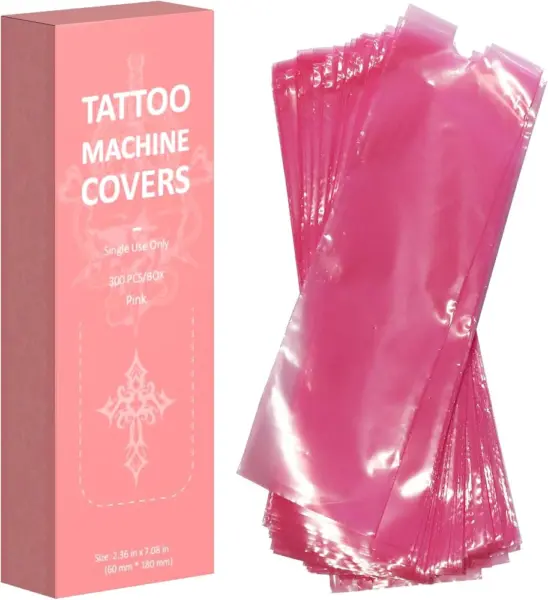
ZHOOGE Pink Pen Covers – Best Bulk Pack
Key Features
- Material: Water-resistant polyethylene
- Cover color: Pink
- Sleeve size: 2.4 × 7 in
- Pack contents: 300 covers
- Price: Budget
In a shared studio, the useful thing about a colored cover is not the color. It is that a bagged machine looks bagged: you can see at a glance which pen is ready for the next client and which one is still waiting, without picking either of them up.
Three hundred sleeves to the box is the biggest count here, at 2.4 by 7 inches with a pre-punched opening. For a chair that changes covers several times a day, that is a box you are not reordering constantly, and the film is water-resistant enough that spray and ink stay on the outside where they belong.
The walls are thin in the good way. The sleeve flexes around the pen body without adding bulk, so the machine still feels like the machine in your hand and you can rotate it through a line the way you normally do.
Where this earns its spot is a studio that color-codes its kit. Pink does a job clear plastic cannot, 300 of them means the box lives under the chair rather than on the shopping list, and a covered machine stays identifiable at a glance. On a single-artist bench where nothing gets swapped, the pink is decoration.
Pros
- 300 covers, the largest pack here
- Pink makes a bagged machine obvious
- Thin walls without adding bulk
Cons
- No grip tape with 300 covers
We like these for any studio that color-codes its kit: 300 sleeves, and a bagged machine you can spot across the room.
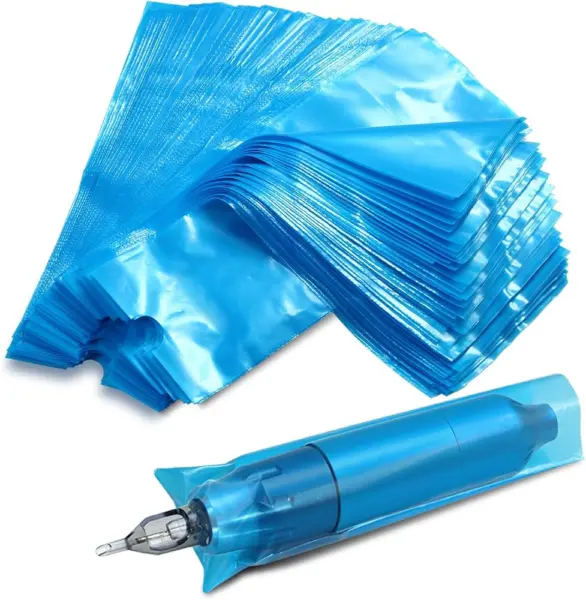
EZ Tattoo Machine Covers – Best for Slim Pen Machines
Key Features
- Opening: Pre-punched hole
- Cover color: Blue
- Sleeve size: 2.4 × 7 in (60 × 180 mm)
- Pack contents: 200 covers
- Price: Budget
Blue is doing real work here. A tinted sleeve reads as covered from across the room, and it does not show the ink haze that turns clear plastic cloudy halfway through a session. On a bench where several machines are out at once, that visibility matters more than the color itself.
What is in the box is 200 sleeves at 2.4 by 7 inches, pre-punched at the bottom, in the plastic weight most pen covers settle at. The listed fit is the Cheyenne Hawk Pen, the EZ Filter Pen and other standard pen types, which is honest: this is the standard size, and standard means slim.
For slim pens, this is the least fussy box in the group: no tape you did not ask for, no closure to line up, just a sleeve that slides on and peels off at the end of the client. We keep a box for the pens that do not carry a battery pack and put the wider Sotica sleeves on the ones that do. Two sizes on the shelf is a system, and it costs less than forcing one sleeve to do both jobs.
Pros
- Standard 2.4 by 7 inch fit for slim pens
- Blue tint reads as covered at a glance
- Pre-punched hole and film that holds
Cons
- Snug over machines with a battery pack
We keep the standard 2.4-inch sleeve for slim pens like the Cheyenne Hawk; it is snug on battery machines and the simplest way to try the format.
Urknall Pen Covers + Wraps – Best for Blue Cover Bundles
Key Features
- Colors: Blue covers, black wraps
- Material: Smooth plastic
- Pack contents: 200 covers + 4 grip wraps
- Price: Midrange
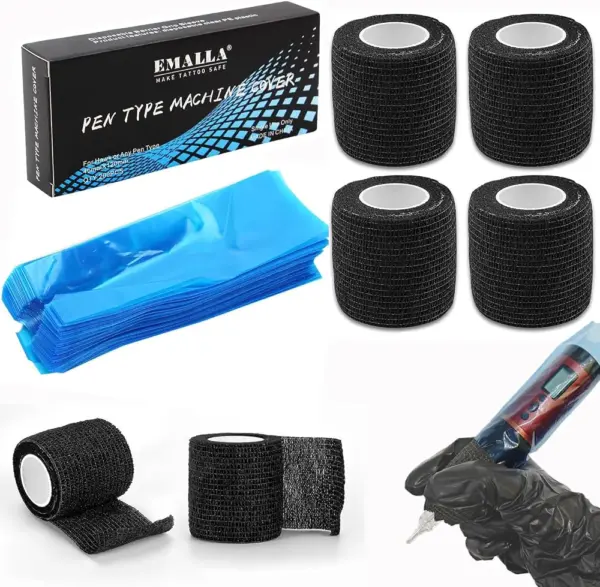
The thing you cannot find on this listing is the sleeve size. Two hundred blue covers and four black grip wraps, smooth plastic, a hygiene barrier, and no width or length anywhere in the description. That is not a dealbreaker if you already know your machine, and it is a real problem if this is your first box.
Where fit is mentioned it comes back good: the sleeves go over a Bishop packer without a fight, and once they are on they stay put through a full session instead of creeping up the barrel. The wraps are the same elastic self-adhesive fabric as the other bundles here, in black rather than the usual beige, and the blue tint lets you make out the machine’s shape through the cover.
What it is not is a first box. Without a stated dimension you are guessing at the one number that decides whether a cover works at all, and four wraps do not change that. If you know your pen and you want blue covers with black wraps, this is a tidy kit with the best-looking wrap here. If you do not, start with a listing that tells you what you are buying.
Pros
- Blue covers with black grip wraps
- Sleeves stay on through a session
- Stretchy wrap with a non-slip grip
Cons
- Sleeve dimensions not stated in the listing
We cannot tell you which machines this fits, because the listing never states a sleeve size, but the blue covers and black wraps are a solid kit once you have measured.
Miuxia Pen Covers + Grip Tape – Best for Black Cover Bundles
Key Features
- Cover color: Black
- Sleeve size: 7.09 × 2.56 in
- Pack contents: 200 covers + 4 grip tapes
- Grip tape size: 2 in × 5 yd
- Price: Midrange
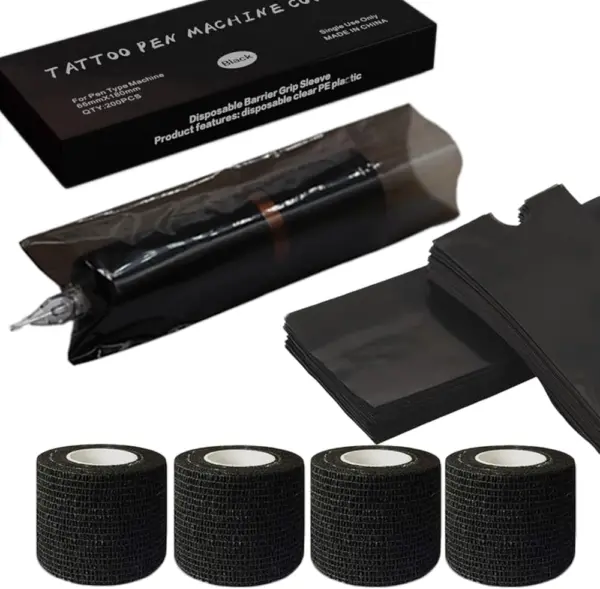
This box does almost exactly what our top pick does, for the same money: 200 black covers at 7.09 by 2.56 inches plus four rolls of 2-inch wrap. The sleeve is the same generous cut that clears a taped grip, and black is the most forgiving color a working machine can wear.
The wrap is the elastic compression type, 2 inches wide and 5 yards to the roll, self-adhesive and breathable, and it peels off the grip without leaving adhesive behind. It is the same fabric the better bundles use, and four rolls covers the setups where you want extra cushioning before you need to restock.
Where this earns a place rather than a shrug is the color. Black film hides ink, looks deliberate on a black-coded station, and does not show every smudge the way clear plastic does. If your kit is black, this is the box that matches it.
Pros
- Black film hides ink and smudges
- 2.56 by 7.09 inch sleeves clear taped grips
- Four 2-inch by 5-yard grip tapes included
Cons
- Fewer wraps than the top pick for the same money
We rate this one for a black-coded station: it costs what our top pick does and gives you four wraps instead of six.
Denergy Pen Covers – Best for Visible Machine Displays
Key Features
- Packaging: Individually sealed
- Cover color: Black, transparent
- Sleeve size: 2.0 × 6.9 in (50 × 175 mm)
- Pack contents: 200 covers
- Price: Budget
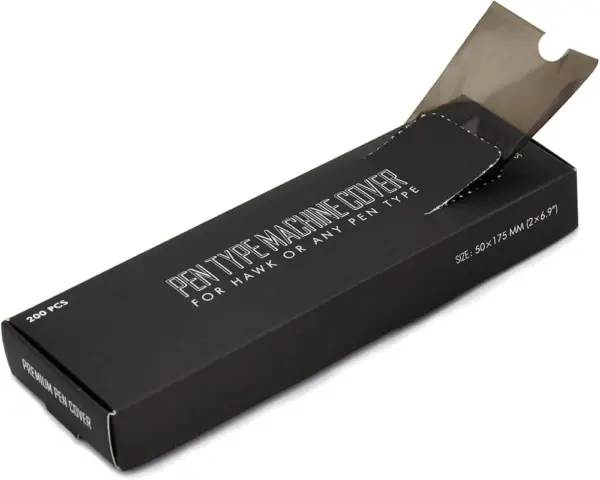
Each sleeve in this box comes individually wrapped, which matters more than it sounds. A cover that is already torn or stuck to the one behind it when it comes out of a bulk box is a cover you throw away, and you find that out in the middle of a setup rather than before it.
The other thing this box does differently is the film. It is black-tinted but clear enough to read the machine’s display through it, so you can check voltage without peeling the cover back. On a long session where you are adjusting as you go, that is worth more than an extra half inch of width.
Two hundred covers to a box, pre-punched at the bottom, and the seams take a reasonable amount of tension before they give. The individual wrapping also means the sleeves at the bottom of the box are in the same condition as the ones at the top.
This is the box we reach for on detail work with a slim pen, where glancing at the display matters more than a forgiving fit. Nothing else here is individually wrapped, and for a studio that wants unused covers clean until the moment they are needed, that is the whole argument.
Pros
- Individually wrapped, so unused covers stay clean
- Clear enough to read the machine’s display
- Pre-punched for cartridges, 200 to the box
Cons
- Narrow 2-inch cut will not clear fat battery packs
We keep these for detail work on slim pens: individually wrapped, clear enough to read a display, and narrow.
How We Chose and Tested Tattoo Machine Covers
We built the shortlist by pulling covers from brands we already use in the studio and adding options that kept surfacing in shop supply orders and tattoo forums. We filtered by material thickness, the sizes each brand offered for pen-style and coil machines, and pack counts, aiming for a mix of thin disposable sleeves and thicker covers.
Testing ran for three months in a working studio, across setup, long shading sessions, and teardown. We slipped each of the 14 covers over a pen-style rotary machine and a coil machine, noting whether it went on without snagging, whether it left the cord junction exposed, and whether it blocked the buttons or stroke adjustment. We wiped machines down with green soap and alcohol between clients and watched for tears at the seams or punctures near the grip. For fit and coverage, we checked whether the cover stayed snug when we rotated the machine in our hands and whether the entire barrel was protected without bunching.
Durability got its own round: we rolled the covered machine in our palms, set it down on the workstation, and ran full four-hour sessions to see if the material stretched or split. Grip was easy to judge—did the cover feel slick when our hands were sweaty or gloved, or did it hold like a second skin? We also timed application with gloves on, one-handed, and counted how many covers we went through in a week to get a sense of value. The best covers were the ones we forgot we were wearing.
How to Choose Tattoo Machine Covers
The number that decides whether a box of covers works for you is the widest point of your machine, not the width of the pen barrel.
Match the sleeve to the widest point, not the barrel
Covers are sold by flat width, and a 2.4-inch sleeve opens to roughly 4.8 inches around. That wraps a slim pen comfortably and fights a battery pack. Measure across the machine where it is actually widest, which usually means over the grip tape rather than the bare barrel, then buy against that figure.
2.0 inches is a slim-pen cut, 2.4 is the standard, and 2.56 to 2.7 is where battery machines and built-up grips live. Buying wide to be safe has its own cost: a loose sleeve gathers where you hold the pen and shifts when you rotate, so buy the tightest sleeve that goes on without a fight.
Open end or sealing strip
Every cover in this group has a pre-punched hole at the bottom for the cartridge; the difference is the other end. An open bag is the fastest thing to put on and the easiest to fold back over a battery. A sealing strip, as on the Silverhorse, closes the mouth so the sleeve cannot ride up and splatter stays outside, at the cost of one more press at every changeover.
For wet work, the seal earns that press. For a fast chair where you change sleeves between every client, an open bag is quicker and there is nothing to line up.
Weigh bundles against covers-only boxes
Most packs here throw in a few rolls of grip wrap, and the arithmetic rarely favors the bundle: 200 covers against six wraps means the tape runs out long before the sleeves do. Buy a bundle if you want to try the wrap fabric or you are starting from nothing.
If you already have a tape you like, the covers-only boxes are both cheaper and the sensible way to test a new size before committing to a bigger count.
Look at the film, not just the count
You want plastic that slides rather than grabs, and bags that open at the punched end instead of tearing down the seam. A sleeve that arrives welded to the one behind it wastes setup time you do not have mid-client.
Tint matters too. Clear shows the machine’s display and every ink smudge, black hides the mess and dims the readout, and blue or pink sit between the two while making a covered machine obvious from across the room. If you adjust voltage by eye, buy a color you can read the screen through.
Frequently Asked Questions
Can you reuse tattoo machine covers?
No. These are single-use barriers, and reusing one defeats the point: the outside has already met whatever was on your gloves and on the machine. Change the cover between clients, and swap it mid-session if it tears, slips, or picks up visible ink.
Count one per setup plus a spare, so a 200-count box is 200 setups. That is the simplest way to work out what to order.
Will a pen cover fit a coil machine?
Usually not. These sleeves are cut for pen-style bodies: a straight barrel with a battery or cord at one end. A coil frame has binding posts and an armature bar that need a wider bag or a wrap instead.
Compare the frame’s widest point with the flat width of the sleeve before ordering. The widest cover here is 2.7 inches, and anything broader than that needs a different format entirely.
Machine covers or barrier film: which should I use?
Sleeves are faster. You open one, slide it on, and you are done, which is why they suit pen machines with a predictable shape.
Barrier film wraps around odd geometry, such as a coil frame, a cord junction, or a foot pedal, and clings to itself. Plenty of artists keep both: sleeves for the pen, film for everything around it.
How many covers should I keep on hand?
One per setup, plus one spare per session for tears and re-bags. That makes the count on the box your planning number: 200 covers is 200 setups, 300 is 300.
Buy the smaller box the first time you try a new size, then move up to the bigger count once you know the fit is right.
Final Verdict
The Sotica box is the one we point people to. A 2.56-inch sleeve goes over a taped grip without a fight, six wraps get you started, and the plastic opens cleanly instead of splitting at the seam.
If your machine carries a fat battery pack, go wider and cheaper with the Bysiter. If splatter is what worries you, the Silverhorse’s sealing strip is worth the extra press at changeover. Everyone else can stop at the first box.