This post contains affiliate links. We may earn a small commission when you buy through our links — at no extra cost to you.
A tattoo pen cover is a small detail that can derail a session if it splits or slides around under your grip. I’ve seen covers bunch at the tip, tear over a pen clip, or leave sticky residue on the machine. The right cover disappears—you put it on, forget it, and focus on the tattoo. That means a snug fit across different pen models, material that won’t rip mid-line, and a texture that keeps your grip steady even when your gloves get inky.
Over the past three months, I’ve been testing covers with a rotating crew of three tattoo artists in a working studio—we went through 14 packs, from thin sleeves to thicker, textured options. Quick lesson: the cheapest covers often cost more in frustration, because they tear or slip. We evaluated each pack on quality, functionality, value, grip, ease of use, and appearance, while paying close attention to fit and durability. The picks below are the ones that held up through back-to-back sessions without getting in the way.
Our Top Picks
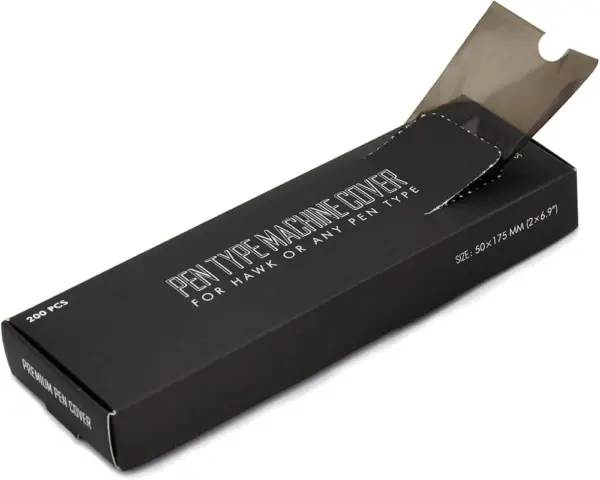
The Best Tattoo Pen Machine Covers, Reviewed
Sotica Pen Cover Kit – Best Overall
Key Features
- Opening: Pre-punched hole
- Grip tape: 6 rolls included
- Cover size: 2.56 x 7.09 in
- Pack count: 200 covers
- Price: Midrange
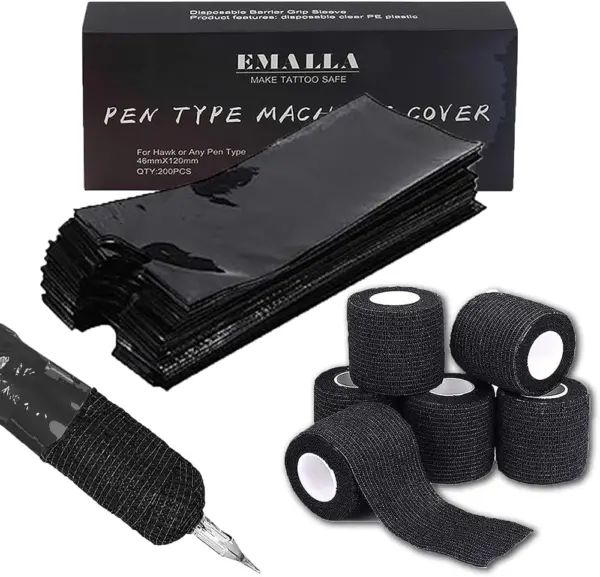
The 2.56-inch width is what makes the Sotica cover the one we reach for first. It slides over a standard pen and grip without the stretch-and-hope routine that narrower sleeves demand, and the 7.09-inch length leaves enough room for the battery section. The box also includes six grip wraps, so a new box restocks the two things we use most in the same order.
What we noticed during setup is how little the cover interferes. The pre-punched hole lines up with the cartridge without cutting, and the plastic has enough body to slide on without splitting at the seam. The grip tape sticks to itself rather than to the machine, which makes it easy to tear a length and wrap a grip without leaving residue.
The missing piece is a seal. This is an open-end sleeve with a pre-punched hole, not a zip-closure bag, so if you work with heavy ink spray or want the cover locked closed, the Silverhorse is the better shape. For ordinary pen work, though, the Sotica kit is the cleanest all-round default here, and the six tape rolls are a quiet win when you are setting up in a hurry.
Pros
- Roomy 2.56 x 7.09 in sleeve
- Six grip tape rolls included
- Pre-punched hole speeds setup
- Slides on without splitting
Cons
- No sealing strip at the opening
For standard pen machines, the Sotica kit is our default: a roomy 2.56 x 7.09 in cover, six grip rolls, and no fit penalty.
Bysiter Large Pen Covers – Best for Large Machines
Key Features
- Opening: Pre-punched hole
- Cover size: 2.7 x 7.5 in
- Pack count: 200 covers
- Machine fit: Large wireless pens
- Price: Budget
The Bysiter box is the size outlier in the best way: 2.7 inches wide and 7.5 inches long, enough to drop over a wireless pen and its battery pack without fighting the plastic. We kept it on the bench for the thicker machines in our test set, where a standard 2.4-inch sleeve turns into a stretch exercise.
The pre-punched hole sits where it should, and the 200-cover count makes it an easy box to keep around for large-machine sessions. The trade-off is looseness: on a slim rotary, the extra material bunches around the grip, and you have to smooth it down before the cartridge goes in. That is not a defect so much as the reason this cover exists.
Durability is the one thing to watch. The plastic is serviceable, but the box can include covers that are stuck shut or cut poorly, so check a few before a busy day. For a large pen, though, the fit is the feature, and Bysiter delivers it at the budget end of this group.
Pros
- Largest sleeve here at 2.7 x 7.5 in
- Fits wireless battery pens
- Pre-punched cartridge hole
- Budget-friendly 200-cover box
Cons
- Loose on slim rotary pens
- Some covers can arrive stuck shut
If your pen is a chunky wireless model, the Bysiter’s 2.7 x 7.5 in sleeve is the easiest fit here; just expect a loose cover on slim rotaries.
Silverhorse Sealable Covers – Best Sealable
Key Features
- Closure: Sealing strip
- Material: High-grade plastic
- Cover size: 2.4 x 8 in
- Pack count: 200 covers
- Price: Budget
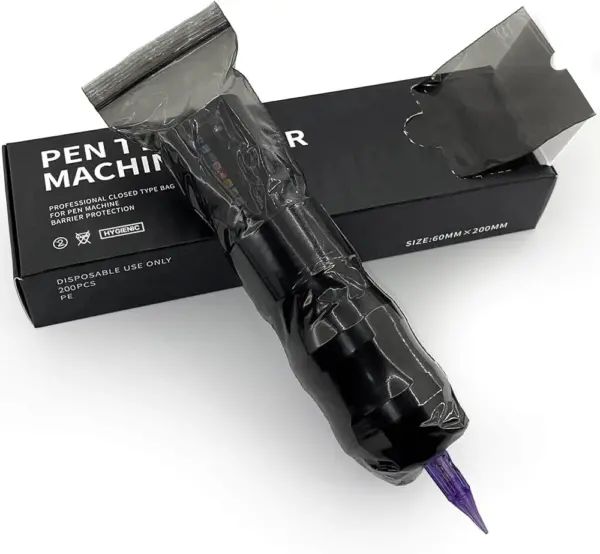
A sealing strip changes the cover from a sleeve you slide on to a barrier you close. The Silverhorse adds that strip to a 2.4 x 8 inch bag, with the extra length covering the back of a longer pen and the seal keeping ink and splatter away from the open end. For color work or any session where the machine gets messy, that is a practical difference.
We liked the quick setup: open, slide the pen in, and seal the back. The seal also makes teardown cleaner, because you can close the bag before dropping it in the waste. The plastic is not the heaviest here, though, and it can split if you force it over a thick grip; the 8-inch length gives you room, but the width is still a standard 2.4 inches.
That is the line to know before ordering: it is a standard-width sealed cover, not a large-machine cover. If your grip is oversize, Bysiter’s 2.7-inch sleeve is the safer fit. If you want a closed barrier and your pen is standard, the Silverhorse is the best sealable option in this set.
Pros
- Sealing strip closes the open end
- 8-inch length covers longer pens
- Cleaner teardown after sessions
Cons
- Can tear when stretched over large grips
The Silverhorse cover is the one for artists who want a sealed bag: the 2.4 x 8 in sleeve closes over the machine, though it can tear if you stretch it over a large grip.
ZHOOGE 300-Pack – Best Bulk Pack
Key Features
- Opening: Pre-punched hole
- Material: Polyethylene
- Cover size: 2.4 x 7 in
- Pack count: 300 covers
- Price: Budget
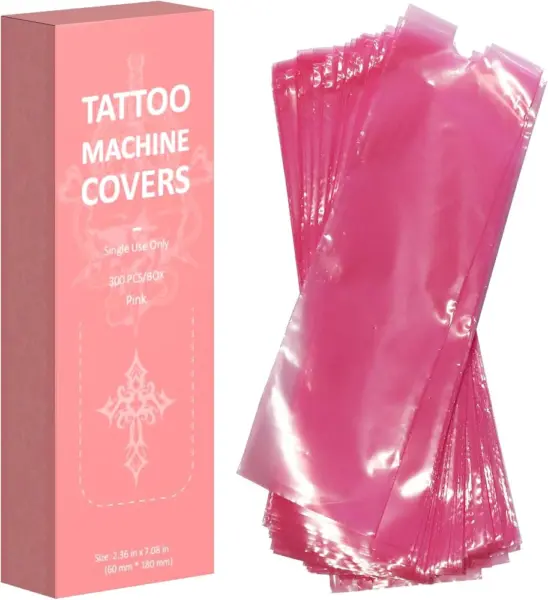
Three hundred covers is the reason this box exists. If several artists share a station, or you cover more than one machine between cleanups, the ZHOOGE box keeps you from running out mid-week. The 2.4 x 7 inch sleeve fits standard pen machines and wireless battery pens, and the pink color makes a covered pen obvious at a glance.
The polyethylene is light enough that it does not turn a pen into a bulky handful. We found the cover easy to slide on, with the pre-punched opening doing its job, and the pink is useful in a shared studio where machines look alike. The fit is the caveat: on a slim rotary, the 2.4-inch width can feel baggy. For a standard or slightly chunky pen, it is closer to right.
If you are a solo artist with a slim pen, the Denergy 2.0-inch sleeve is the neater match. If you are stocking a studio and want a color-coded cover that disappears into the routine, the ZHOOGE pack is the one to keep in the cabinet.
Pros
- 300 covers per box
- Fits standard and wireless pens
- Pink cover is easy to identify
- Lightweight sleeve adds little bulk
Cons
- Baggy on slim rotary machines
The ZHOOGE 300-pack is the studio stock-up: standard 2.4 x 7 in covers, a bright pink shell for quick identification, and enough pieces to stop reordering every week.
Denergy Slim Pen Covers – Best for Slim Pens
Key Features
- Cover size: 2.0 x 6.9 in
- Pack count: 200 covers
- Visibility: Clear voltage window
- Machine fit: Pens up to 33 mm
- Price: Budget
A 2.0-inch sleeve is the slim option, and the Denergy cover makes the most of it. The 6.9-inch length covers a cartridge battery pen without a flap of extra plastic, and the clear material lets you see the voltage display without peeling the cover back. If you run a slim pen, that visibility is a small but constant convenience.
The listed fit is pens up to 33 mm in diameter, and that is the line to respect. On a standard pen it goes on cleanly; over a thick grip or a larger battery pack, it becomes a tight stretch and can split. We treated it as a dedicated slim-pen cover rather than a universal one, and that is how it performs best.
The packaging is individually removable, which makes it easy to grab one without unfolding the whole stack. For a standard machine, Sotica’s 2.56-inch cover gives you more room. For a slim pen, the Denergy is the cleaner, less bulky choice.
Pros
- Slim 2.0 x 6.9 in fit
- Clear material shows voltage
- Fits pens up to 33 mm
- Individually removable packaging
Cons
- Too tight for machines wider than 33 mm
For slim battery pens up to 33 mm, the Denergy cover is the neatest fit here: a 2.0 x 6.9 in sleeve with a clear window for checking voltage.
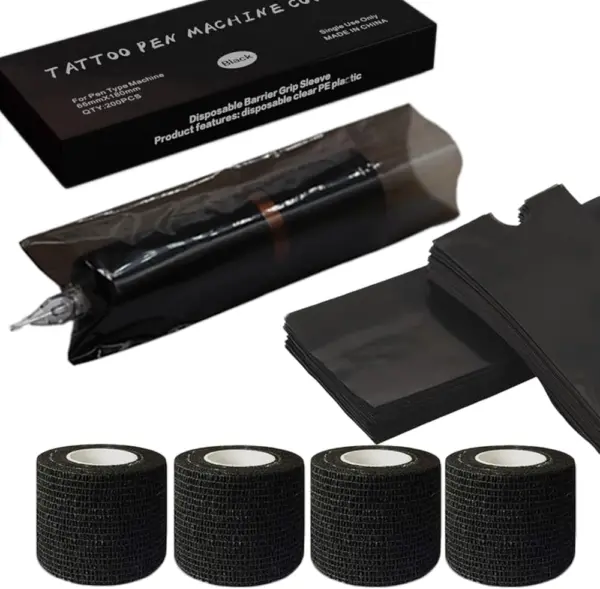
Miuxia Cover & Grip Kit – Best for Bundle Buyers
Key Features
- Opening: Pre-cut opening
- Grip tape: 4 rolls included
- Cover size: 7.09 x 2.56 in
- Pack count: 200 covers
- Price: Midrange
The bundle is the appeal: 200 covers and four grip wraps in one box, with a 2.56 x 7.09 inch sleeve that fits standard pen machines. If you like keeping covers and tape together, it is an easy box to order.
We were less impressed by the grip wraps. They can move around during a session, and the bags are not the most tear-resistant in this group. The covers themselves do the job, and the pre-cut opening saves a step, but the kit does not feel as sorted as the Sotica bundle, which adds two more tape rolls and has held up better in our setup.
If you want a roomy cover and a spare tape roll, the Miuxia is fine. If grip security is the reason you are buying a kit, choose the Sotica and skip the fiddling.
Pros
- 204-piece cover-and-tape bundle
- Roomy 2.56 x 7.09 in cover
- Pre-cut opening saves a step
- Fits standard rotary pens
Cons
- Grip tape can slip during use
- Bags can tear during use
The Miuxia kit is a decent cover-and-tape bundle for standard pens, but the grip tape can slip and the bags are not the toughest here.
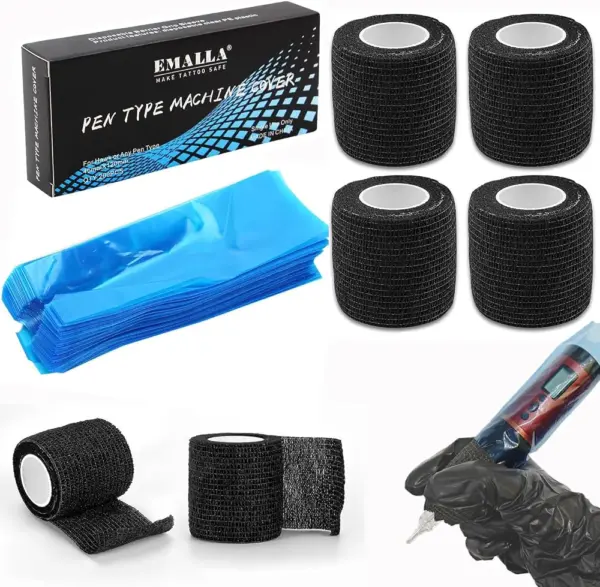
Urknall Cover & Grip Kit – Best for Color-Coded Setups
Key Features
- Material: Smooth plastic
- Grip tape: 4 rolls included
- Pack count: 200 covers
- Grip material: Stretch fabric
- Price: Midrange
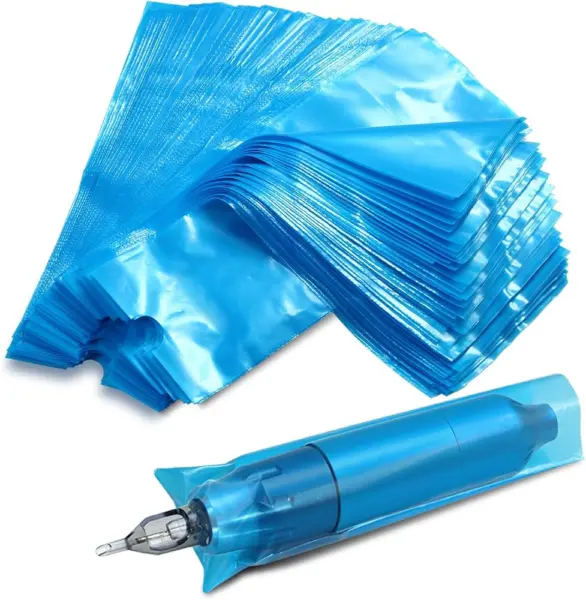
The blue covers are the first thing you notice, and that is not just decoration. In a shared setup, a colored sleeve makes it obvious which pen is covered, and the box adds four black grip wraps so the whole station gets restocked at once.
The plastic has a smooth, residue-free feel that slides over a standard pen, and the grip wrap is stretchy enough to wrap a handle without bulk. We also appreciated that the covers stay put once they are on, rather than creeping up the barrel during use.
The caveat is separation. Covers can arrive fused at the seams, and a fused cover is useless if it will not open. Check a few from the box before a busy day, and if you get a bad batch, deal with it before the client is in the chair.
There is also no sleeve dimension given, which makes fit the one question to settle before ordering. For a known standard pen, the Sotica kit is the safer default; for a cheap blue bundle and a spare grip roll, Urknall is worth a look.
Pros
- Blue covers are easy to identify
- Four grip wraps included
- Smooth plastic barrier
- Grip tape reduces hand fatigue
Cons
- Covers can arrive fused together
The Urknall bundle is a good-value blue cover set with four grip wraps, but check the stack for fused covers before you start a session.
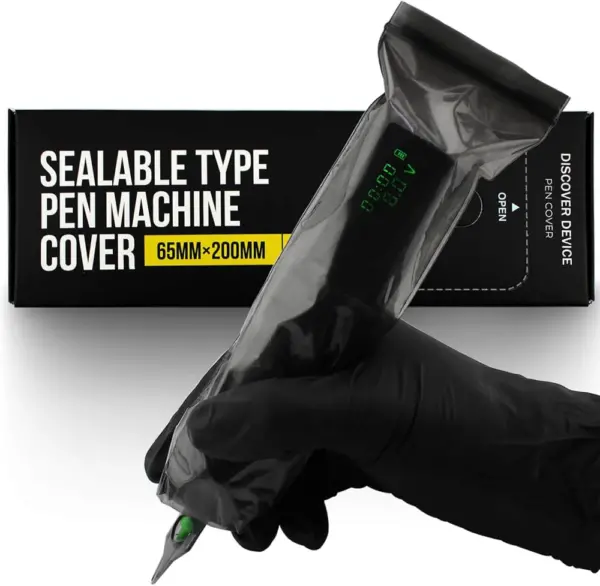
Discover Device Sealable Covers – Large Sealed Coverage
Key Features
- Closure: Sealing strip
- Opening: Small pre-cut hole
- Cover size: 2.5 x 7.8 in
- Pack count: 200 covers
- Price: Midrange
Discover Device takes the sealable idea and stretches it to 2.5 x 7.8 inches, which is the size to look at when a standard 2.4-inch bag is tight over a grip or battery. The sealing strip runs across the opening, and the small pre-cut hole keeps the cartridge connection neat.
We liked the extra width more than the seal itself. It gives a large machine room to sit without the cover pulling tight across the controls, and the seal is useful for messy sessions: you can close the bag before cleanup instead of trying to gather an open end.
The upper size limit is still a size limit; a very thick grip can make the seal hard to close. If your pen is standard, the Silverhorse is the cleaner fit and the seal is just as useful. If your pen is big and you want the opening closed, the extra room here earns its place.
This is the one to try when a 2.4-inch sealed cover will not go on, and you do not want to give up the closure. It is not the default for standard pens; it is the large-machine answer.
Pros
- Large 2.5 x 7.8 in sleeve
- Sealing strip closes the opening
- Small pre-cut cartridge hole
- Fits larger rotary machines
Cons
- Seal can be hard to close over very thick grips
The Discover Device cover is a large sealable sleeve for big machines, with a 2.5 x 7.8 in fit and a closure that keeps the open end under control.
How We Tested Tattoo Pen Covers
We started by gathering every pen cover we could find from major tattoo suppliers, filtering out anything with consistent complaints about tearing or poor fit. That left us with 14 packs representing the range of materials, thicknesses, and pack sizes. We handed them to three artists—each with different pen models and hand sizes—who used the covers during real client sessions over three months, from small linework to multi-hour shading.
Testing happened in a working studio, not a lab. Artists applied covers with gloves on, noted how easily they rolled over pen clips and buttons, and whether they stayed snug during long shading passes. We checked durability by stretching each cover over a pen, tugging at the seams, then using it for a full session and inspecting for rips or thinning. Fit was assessed across three popular pen shapes—slim, standard, and thick-grip—and we noted if covers bunched at the tip or left gaps near the cartridge.
For grip, artists rated how the cover felt when their hands got sweaty or inky—some materials turned slick, others stayed tacky. We also looked at appearance: clarity (could you see indicator lights through the cover?), color, and whether the cover looked professional or cheap. Value was calculated as cost per cover, factoring in how many we actually used per session (some tore on application, wasting a cover). The covers that made our list are the ones that disappeared into the workflow—no fuss, no failures.
How to Choose Tattoo Pen Machine Covers
The cover that fits your machine and grip is worth more than a bigger pack count; everything else follows from that.
Fit the sleeve to the machine, not the needle
The most common miss is buying a standard 2.4-inch cover for a pen with a thick grip or a battery pack. Width matters more than length: 2.0 inches is the slim option, 2.4 to 2.56 inches is the standard range, and 2.7 inches is the one for chunky wireless machines. If the cover has to stretch hard to get past the grip, it is the wrong cover, even if the packet says pen machine.
Check the diameter your machine is rated for. The Denergy cover lists a 33 mm limit; the Bysiter is the widest here at 2.7 inches. A cover that is baggy on a slim pen is annoying but usable; one that splits on a large pen is not. We size up for a big grip rather than force a standard sleeve.
Open end or sealable strip
A pre-punched hole gives you a fast slide-on cover: the cartridge passes through the hole, and the back stays open. A sealing strip adds a closure at the back, which helps when ink or fluid is flying and makes teardown cleaner. The Silverhorse and Discover Device use that design; the Sotica and Bysiter do not.
The seal is not automatically better. It adds a step, and on a very thick grip the strip can be hard to close. If you change covers between clients and want speed, open-end is simpler. If you work messy color or want the cover closed before it hits the waste bin, pay for the seal.
Pack count, grip tape, and the bundle trap
Two hundred covers is the usual box; three hundred is the studio size. The bigger number only matters if you will use it before the box takes over a drawer. A 300-pack like the ZHOOGE is a good fit for a shared station; a solo artist with one machine may prefer the smaller standard box.
Grip tape in the box is useful, but not all grip tape is equal. The Miuxia bundle includes four rolls, and the tape can slip; the Sotica kit includes six, and the tape holds without residue. If grip security is the reason you are buying a kit, the tape matters as much as the covers.
Tear resistance, seams, and the first cover
The plastic has to survive being opened, slid over a grip, and pulled off after the session. Thin covers can split at the seam, and a box can arrive with covers fused together, especially if the stack was cut or stored badly. Check the first few from a new box before a client is in the chair.
Our preference is a cover with enough body to slide on without stretching and a seam that does not give way when you pull it over a battery pack. The Sotica cover is the most consistent here; the Silverhorse is easier to tear if you force it over a large grip. A split at the seam means the fit was wrong or the plastic was too thin.
Frequently Asked Questions
Do I need a pen cover if I already wear gloves?
Yes. Gloves protect your hands, but they do not stop ink, blood, or splatter from reaching the machine. A disposable cover gives you a barrier over the pen and grip, and it makes cleanup faster between clients.
Can I use these covers on a coil tattoo machine?
No. These are pen-machine sleeves, cut for rotary and battery pens with a narrow barrel. A coil machine has a different frame and grip shape, so use a coil-specific bag or barrier film instead. Check the cover’s stated diameter before ordering if you run anything unusual.
Are tattoo pen covers sterile?
Treat them as disposable barriers, not sterile surgical supplies. Some boxes, including the Denergy covers, describe EO gas sterilization packaging; others do not make that claim. If sterility matters for your setup, read the package wording before you buy and do not assume it carries across brands.
How often should I change a pen cover?
Use a new cover for each client, and replace it immediately if it tears, slips down, or gets soaked with ink or fluid. Do not wipe a used cover and put it back on. A split barrier is worse than no cover because it can hide contamination.
Final Verdict
Most artists should start with the Sotica kit. It has the roomiest standard-pen sleeve in this group, six grip rolls in the box, and the fewest fit compromises among the covers here. If your machine is a chunky wireless pen, go to the Bysiter; if you want a sealed bag, choose the Silverhorse. The rest of the list is for a specific fit or a specific count, not a better all-round default.