This post contains affiliate links. We may earn a small commission when you buy through our links — at no extra cost to you.
A tattoo machine is the most expensive thing in your kit, and the bag you carry it in is the only thing standing between it and a cracked frame. I learned that the hard way after a soft duffel let a power supply slide into a coil machine during a guest spot. A good bag fixes that: it holds every machine, cord, and bottle where you put it, and it keeps the whole setup protected when you move between the studio, the car, and a convention floor.
Over the past six months, my team and I have packed and unpacked 12 tattoo machine bags for daily studio shifts and weekend conventions. A bag can be the right size and still be wrong if the interior doesn’t fit your machines snugly or the padding stops short of the corners. We wanted to know which ones kept their shape after repeated loading, which handles stayed secure in a sweaty grip, and which layouts let us reach a machine without unpacking the whole bag. The picks below are the ones that held up without costing more than they should.
Our Top Picks
The Best Tattoo Machine Bags, Reviewed
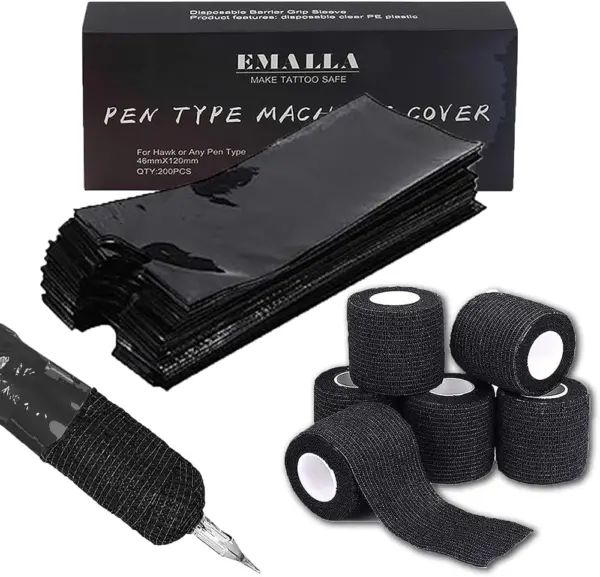
Sotica 200 Pen Covers + 6 Grip Tapes – Best Overall
Key Features
- Closure: Pre-punched hole
- Bag size: 2.56 x 7.09 in
- Grip tape: 6 wraps
- Covers per box: 200
- Price: Budget
Six grip wraps instead of four is the first thing that separates this kit from the pile, and it’s the part we appreciate most. Grip tape is what runs out before the bags do — you cut a fresh strip for every client — and a four-roll bundle rarely makes it to the bottom of the box. The wrap is a compression-bandage fabric that tears by hand, so nobody is hunting for scissors mid-setup.
The bag is where the buying decision sits. At 2.56 by 7.09 inches it runs about a sixth of an inch wider than the 2.4-inch sleeves that dominate this category, and that margin is what lets it slide over a cartridge machine with a wrapped grip instead of being stretched until the seam whitens. The pre-punched hole lines up with the cartridge, so the needle assembly seats through the plastic rather than under it.
Durability is the strongest part of the case. The seams hold when you pull a cover on, and the wrap clings to itself without leaving adhesive behind on the machine — which matters more than it sounds, because residue on a pen means cleaning it before the next client, exactly the job these bags exist to skip.
The ceiling is grip diameter. 2.56 inches clears a standard cartridge machine plus a wrap; a fat silicone grip is a different job, and the widest bag here is the one for that. For the machine most artists actually hold, this is the box that covers everything at once — fit, tape and count.
Pros
- Wider than the common 2.4-inch sleeve
- Six grip wraps in the box, not four
- Wrap clings without leaving residue
- Seams hold up to a hard pull
Cons
- Sold only in translucent black
For most artists this is the box to buy: a wider sleeve that slides over a wrapped grip, plus six grip wraps in the same kit.
Bysiter 200 Large Machine Covers – Best for Big Machines
Key Features
- Closure: Pre-punched hole
- Bag size: 2.7 x 7.5 in (70 x 190 mm)
- Covers per box: 200
- Price: Budget
At 2.7 by 7.5 inches, this is the biggest bag in the group — about a fifth of an inch wider than a standard sleeve and half an inch longer — and it’s also the least expensive box here. That combination is unusual enough to be worth a second look, because most listings charge more for the extra plastic.
It’s the pick for anyone whose machine doesn’t fit a standard cover. A thick battery pack, a silicone-wrapped grip, a pen built up with three layers of tape: all of it goes in with room to spare, and the 7.5-inch length still reaches the switch end. For a shop buying covers by the case, the loose fit is the feature — you’re not stretching a bag at the start of every appointment.
On a slim pen, all that slack works against you. The cover shifts under your fingers instead of staying where you put it, and you want the tighter 2.4-inch fit back. That’s the trade: this bag is generous enough for the awkward machines and too generous for the tidy ones.
The function is plain and it works. The pre-punched hole lines up, the film keeps ink and dust off the machine, and there’s enough slack that a cover goes on one-handed between clients — which is the whole point of a bag over a wrap of cling film. Nothing here is fancy, and nothing here needs to be.
Pros
- Widest bag in this set at 2.7 inches
- 7.5 inches clears the switch end
- The cheapest box here
Cons
- No grip tape in the box
- Some bags arrive with the cut not fully separated
The bag for a machine that won’t fit a standard cover — thick battery packs and wrapped grips go in with room, at the lowest price here.
SILVERHORSE Sealable 200 Covers – Best Sealable
Key Features
- Closure: Sealing strip
- Bag size: 2.4 x 8 in (60 x 205 mm)
- Film color: Black
- Covers per box: 200
- Price: Budget
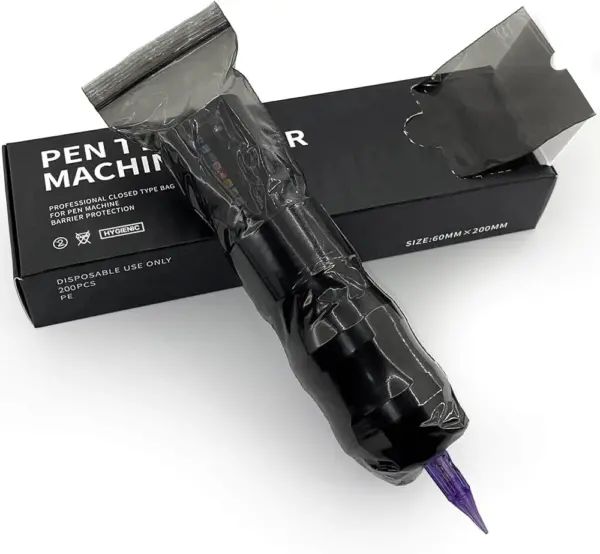
The sealing strip is the whole idea here, and it earns its place. Instead of leaving an open cuff loose around the machine, you close the bag around it — so the cover stays where you put it through a long session, and whatever is on the outside stays outside when you set the pen down.
Eight inches is the other half of that design. The extra inch over a 7-inch sleeve covers the clip-cord end of a corded machine and leaves enough slack for the seal to close without pulling the plastic tight across the body. If you’ve ever had a bag creep up the machine halfway through a piece, length plus closure is the fix.
The limit is width. At 2.4 inches this is a standard sleeve, and standard means the fit gets interesting over a thick grip or a big battery pack — you’ll pull hard enough that the seam is worth watching. Put the cover on before the grip tape and most of that disappears, because the tape takes up the slack and holds the plastic down.
For corded machines especially, the combination is the most useful one here: the length handles the cord side, the seal handles the rest, and the black film means you’re not looking at yesterday’s ink while you work.
Pros
- Sealing strip keeps the cuff closed
- Longest bag in this set at 8 inches
- Black film hides ink splatter
Cons
- Bags only — grip tape sold separately
If you want the cover to stay put and stay closed, this is the one: sealed cuff, longest sleeve here, black film.
Miuxia 200 Pink Covers + 4 Grip Tapes – Best Color-Matched Kit
Key Features
- Bag size: 7.09 x 2.56 in
- Grip tape: 4 wraps
- Film color: Pink
- Covers per box: 200
- Price: Budget
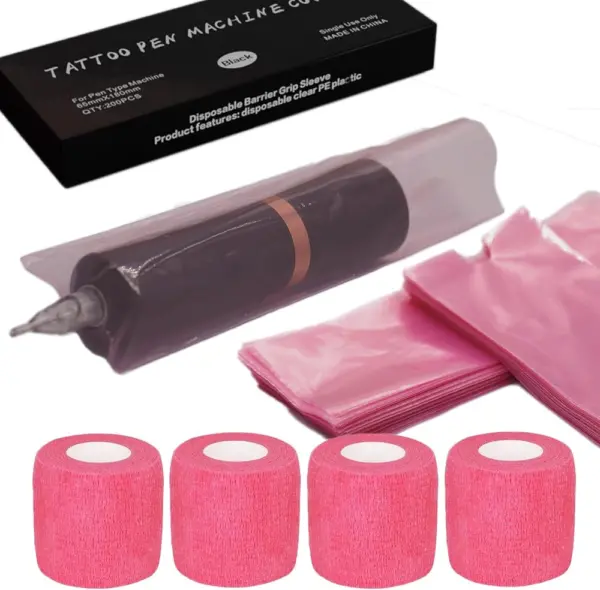
Pink covers, pink wrap, pink station. If your room already runs a color story — bright gloves, matched towels, a setup clients notice — this kit keeps it going instead of dropping a black sleeve into the middle of it. The pink is strong and saturated rather than pastel, so it reads as a choice.
Under the color it’s a 2.56 by 7.09-inch sleeve, the wider end of what’s on this page, and enough to go over a cartridge pen with a wrap on it without a fight. Four rolls of two-inch grip wrap come in the box, and the set feels pulled together rather than assembled from odd bits.
The wrap is the half that needs attention: it grips when it’s snug and creeps when it isn’t, so wind it firmly and check it before a long sitting. Otherwise the kit is exactly what it looks like — matched covers and wrap in one box, with four five-yard rolls to see you through.
Pros
- Bright pink that matches a color-coded station
- 2.56-inch width fits standard rotary pens
- Four grip wraps included
Cons
- Light plastic can split on a hard pull
A matched pink kit with the wider sleeve and four wraps — the right buy if your station already runs one color story.
EZ 200 Machine Covers – Best for Slim Rotary Pens
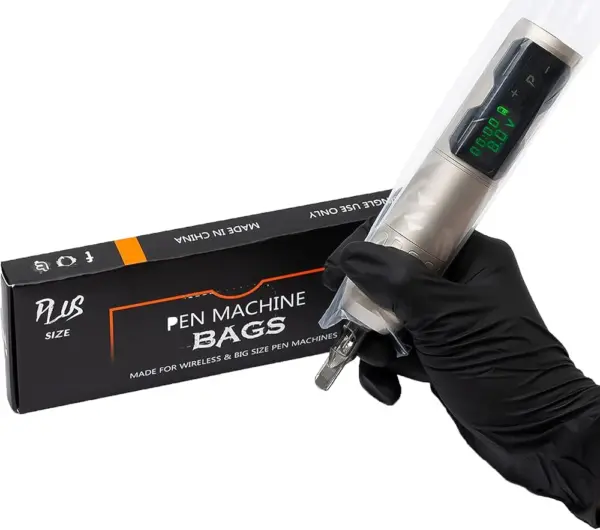
Key Features
- Closure: Pre-punched hole
- Bag size: 2.4 x 7 in (60 x 180 mm)
- Film color: Transparent white
- Covers per box: 200
- Price: Budget
Two tenths of an inch sounds like nothing, but 2.4 inches is where most of this category sits — and it’s where the fit argument starts. This is the classic sleeve: 2.4 by 7 inches, transparent white plastic, a punched hole for the cartridge, nothing else in the box.
Over a slim rotary pen it’s the tightest cover here, in the good sense. The film sits close enough that you keep the machine’s shape and the switch under your fingers, with no ballooning at the grip and no slack to catch on a glove. It goes on in one motion and stays where you put it.
That snugness is the review. A tight bag is a tactile bag, and the thin film is why you can work through it without thinking about the cover at all. The punched hole is clean, the film is clear enough to read a voltage display straight through, and a box of these goes a long way on the pens it fits.
Pros
- Snug, no-bunch fit on slim pens
- Clear film reads a display easily
- Pre-punched hole seats cartridges cleanly
Cons
- Runs narrow for battery packs and thick grips
A tight classic sleeve that feels superb on a slim rotary pen and comes up short on anything with a battery pack bolted on.
Denergy 200 Pen Covers – Best for Battery Pens
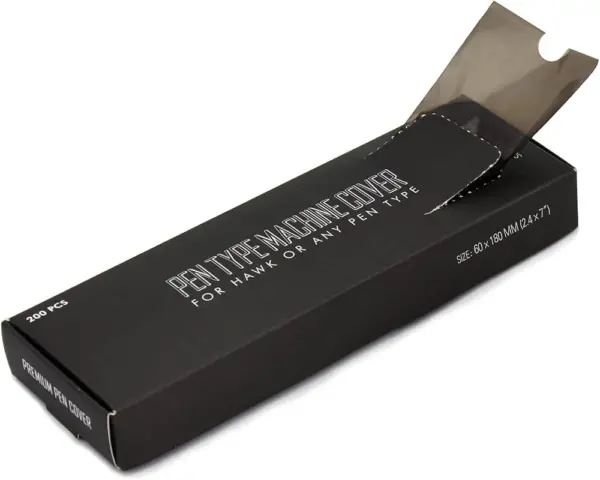
Key Features
- Packing: Individually removable
- Bag size: 2.4 x 7 in (60 x 180 mm)
- Film color: Black and transparent
- Covers per box: 200
- Price: Budget
A dark bag that still lets you read the machine is a small thing that turns out to matter. The film here is black-tinted but transparent enough that a battery pen’s voltage readout stays legible through it, so you’re not peeling a cover back to check power in the middle of a line.
The packing is the other detail worth knowing. Each cover lifts off the stack on its own instead of being torn out of a perforated strip, so you’re not left holding a half-opened bag you then have to throw away. Two hundred per box, pre-punched, in standard 2.4 by 7-inch sizing.
What you give up for that legibility is brightness: the tint dulls the body of the machine compared with clear film, so you see less of the pen overall. For anyone running power off the pen, the trade goes the other way — you keep the one reading you actually check.
Pros
- Voltage display stays legible through the tint
- Covers lift off the stack one at a time
- Standard 2.4 by 7-inch sizing
Cons
- Tight over large grips and battery packs
Buy it if you set power from the pen itself and want to keep reading that display while the machine is covered.
Urknall 200 Covers + 4 Grip Wraps – Best for Shared Stations
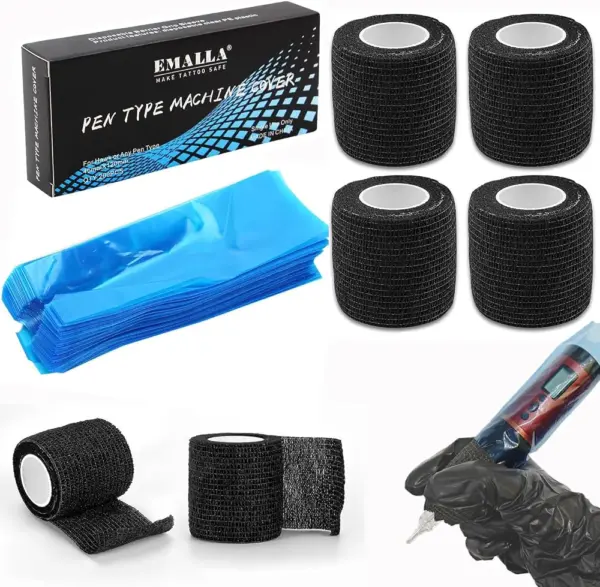
Key Features
- Grip tape: 4 wraps
- Film color: Blue
- Covers per box: 200
- Price: Budget
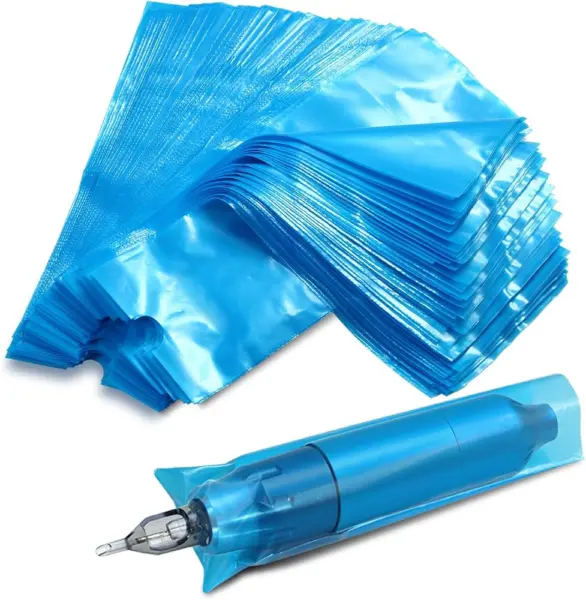
The failure worth knowing about with a budget sleeve isn’t a tear — it’s a box where the edges of the plastic have fused and the covers won’t open. It happens here in some boxes, and it’s worth opening the first stack before a client is in the chair rather than during. Past that, these are straightforward: 200 blue covers, four black grip wraps, a punched hole.
Blue does a job. A colored cover makes it obvious at a glance which machines are bagged and which aren’t, which is genuinely useful when two artists share a station, and it hides ink smudges better than clear film. We liked it more than we expected to — the station reads as organized rather than improvised.
The wrap is the better half of the kit. It’s the stretchy self-adherent type that builds up a grip without adhesive, it holds through a long session, and it comes off with the cover instead of leaving residue on the machine. Fit is the part to test: run one cover over the machine you actually use before you commit a whole box to it.
Pros
- Blue covers are easy to tell apart at a shared station
- Grip wrap holds without adhesive
- Has fitted a Bishop packer with ease
Cons
Blue covers and a self-adherent wrap that leaves nothing behind — worth it if two artists share a station.
Anghie 200 Pink Pen Covers – Best for Bags-Only Buyers
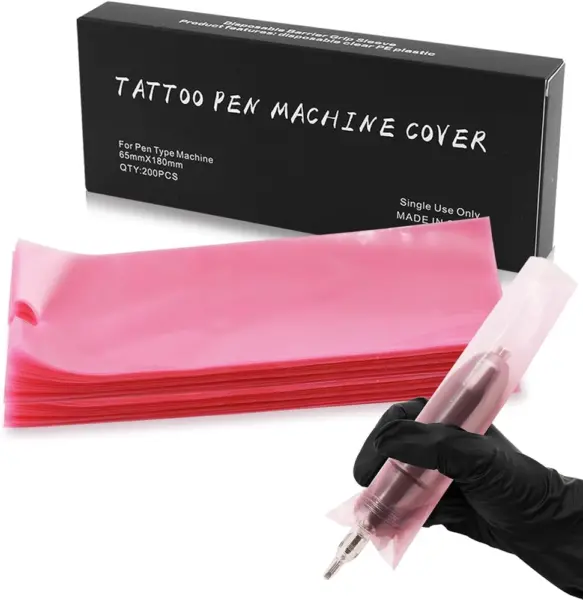
Key Features
- Bag size: 2.56 x 7.09 in (65 x 180 mm)
- Film material: PE plastic
- Covers per box: 200
- Price: Budget
Strip it back and this is two hundred PE bags in a box — no wrap, no seal, no bundle — and for an artist who already has a tape they like, that’s the appeal. The number that matters is 2.56 by 7.09 inches: the wider end of standard, and enough to go over a cartridge machine with a wrap on it.
The PE film has a firmer hand than the soft sleeves here. It opens without you hunting for the edge, and it doesn’t fold in on itself as you pull it over the machine, which is the difference between a cover you fit in one motion and one you fight with while a client waits.
It isn’t a kit, and that’s the decision. For a working artist with a drawer full of wrap, buying covers without paying for someone else’s tape is the sensible move; if you’re kitting out from scratch, one of the bundles gets you further. The sleeve holds up its end either way.
Pros
- Wider 2.56-inch sleeve
- PE film stays firm in the hand
- 200 per box
Cons
- Bags only — no grip tape or seal
Two hundred wide pink sleeves and nothing else — the buy for an artist who already has a wrap they trust.
Rayyl 200 Pen Covers + 4 Grip Tapes – Grip-End Coverage
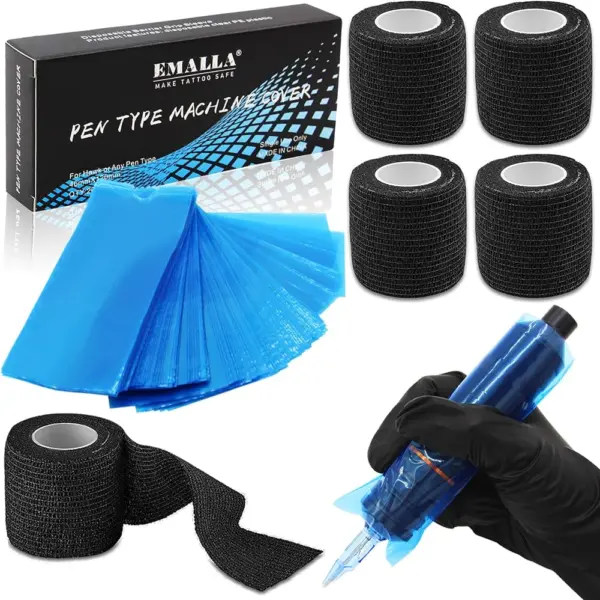
Key Features
- Bag size: 1.77 x 4.72 in
- Grip tape: 4 rolls, 2 in x 5 yd
- Covers per box: 200
- Price: Budget
At 1.77 by 4.72 inches, this is the smallest sleeve here by a wide margin — roughly two-thirds the length of a standard cover and three-quarters the width. That isn’t a flaw in the plastic; it’s a different job, and it’s worth being clear about which one.
The job is the grip end of a slim pen. If you hold a rotary pen like a pencil and only the front few inches need to stay clean, a short sleeve keeps the balance and adds nothing where your fingers sit. Four rolls of two-inch wrap come with it at five yards each, so the tape side of the kit is covered for a long while.
What you’re buying is the tape as much as the plastic. Four five-yard rolls is a serious amount of wrap, and it’s the part of a kit that usually runs out first. The sleeve is the bonus: short, snug, and shaped for a pen you hold close to the tip.
Pros
- Short sleeve keeps a slim pen balanced
- Four rolls of 2-inch wrap, 5 yards each
Cons
- Too short to cover a battery machine
A sleeve for the grip end of a slim pen — it stops well short of a battery pack, and that’s the whole point.
How We Tested Tattoo Machine Bags
We started by pulling together every tattoo machine bag we could find from specialty suppliers and general gear brands, then filtered by interior dimensions, closure type, and whether the layout could hold a standard two-machine setup. That left 12 bags, which we tested for six months.
Each bag was loaded with two machines, a power supply, foot pedal, cords, ink caps, gloves, and a bottle of green soap, then carried by handle and shoulder strap through studio shifts, into a car trunk, and across convention halls. We packed and unpacked each one at the start and end of every shift, noting whether straps dug in or handles stayed grippy with sweaty hands. After each use, we wiped interiors and exteriors with disinfectant wipes and checked seams, zippers, and padding for wear.
We paid attention to fit and size: whether machines sat snug or rattled, whether small bottles disappeared into pockets, and whether the bag still closed when overpacked. Coverage came down to whether padding protected corners and whether the base kept supplies off wet floors. Ease of use meant reaching a machine without unpacking everything, and value was judged by how the bag looked and worked on the last day compared with the first.
How to Choose Tattoo Machine Bags
The number that decides whether a cover works isn’t the length in the title — it’s the flat width, measured against the thickest part of the machine you actually hold.
Width decides the fit, not length
A bag’s flat width roughly doubles as its circumference, so a 2.4-inch sleeve gives you about 4.8 inches to work around the machine. That clears a cartridge pen and a wrap. It does not clear a fat silicone grip or a battery pack bolted to the back, which is why the wider sleeves here run 2.56 to 2.7 inches — that margin is the difference between sliding a cover on and stretching one until the seam whitens.
Ignore the word large in a listing title; it only means large relative to that seller’s range. Pull the grip you actually use and measure across it, then compare the number, not the adjective.
A punched hole or a sealing strip
Every cover on this page has a pre-cut hole for the cartridge. The split is at the open end: a plain cuff stays open, while a sealing strip closes the bag around the machine. A seal keeps a cover from creeping up over a long session and is the better answer for corded machines, where there’s more machine to cover and a cord to catch on.
A seal only works if there’s slack at the cuff, which is why the sealed bags here also run longer. If you want the closure to actually close, buy the eight-inch bag rather than the seven.
Open the box before the client sits down
Two problems turn up in cheap sleeves, and neither announces itself until you’re mid-setup: covers fused at the edges so they won’t open, and pre-cut holes that weren’t cut cleanly through. Both are box-level faults rather than design flaws, and both are cheap to find early. Open the first stack the day it arrives, fit one cover to the machine you’ll use most, and keep the rest of that stack within reach.
A bag that fights you while your hands are clean will be worse at the end of a session, when you’re holding a machine and watching a client.
What the bundles are actually worth
Two hundred covers is the standard box, and the per-cover difference between these kits is small. The tape is where the money moves: four rolls of two-inch wrap is the usual bundle, six is generous, and none at all is the right answer if you already have a wrap you trust.
Match the count to your habits rather than the other way round. If you rewrap a grip for every client, six rolls beat four; if you cut one long strip a day, the difference won’t decide anything.
Frequently Asked Questions
Can I use cling film or barrier film instead of covers?
Barrier film is a roll you wrap and tear; a cover is pre-sized with a punched hole and goes on in one motion. For a pen machine you’ll be holding for hours, a cover is faster between clients and leaves less bunching at the grip.
If your station already runs barrier film for cords and machines, buy covers on their own rather than a bundle with tape you won’t use.
How long does a box of 200 covers last?
One cover per client per machine is the working minimum, so the arithmetic is simple. At four clients a day, five days a week, a 200-count box lasts about ten working days.
Two artists sharing one box will empty it inside a week, so buy two at a time if you share a station and keep a spare within reach for the one that splits.
Can I reuse a cover between clients?
No. Once a cover has been handled it has the same contamination problem as the machine underneath it, and the plastic is thin enough that a second fitting usually ends in a tear anyway.
Peel it off together with the grip tape and fit a fresh one. A reused cover is one more thing to think about in a session that should run on habit.
Final Verdict
Buy the Sotica kit and stop there for most machines. The 2.56-inch width slides over a wrapped grip, the six wraps cover the thing that actually runs out first, and nothing about the bag gets in the way of a session.
If your pen wears a thick grip or a big battery pack, the Bysiter’s 2.7-inch bag goes on without a stretch. If you work corded and want the cover to stay closed, the SILVERHORSE seal is the one to switch to.