This post contains affiliate links. We may earn a small commission when you buy through our links — at no extra cost to you.
The first night home with a fresh tattoo is a particular kind of quiet panic. The wrap comes off, the skin is hot and tight, and you realize you are now the only thing standing between a piece you’ll wear for decades and a scabby, patchy heal. Aftercare is the least glamorous part of getting tattooed and the part most people get wrong: too much ointment and you’re stuck to the sheets, too little and the ink cracks as it dries. A good balm or lotion keeps the surface supple enough to heal flat, calms the sting without provoking redness, and lets the lines settle clean instead of blurring at the edges.
I have sat through enough sessions to have strong opinions about the greasy stuff a shop hands you in a little packet. Over the past three months, my team and I worked through 14 balms, lotions, and ointments on healing work of our own, from a small wrist piece to a full back panel that spent a week under a shirt. The differences were not subtle: some sank in within a minute and left no shine, others sat on top of the skin like butter and transferred onto everything we touched. Scent turned out to matter more than I expected, too, since fragrance is the most common reason a perfectly good formula makes fresh ink angry.
Our Top Picks
The Best Tattoo Aftercare, Reviewed
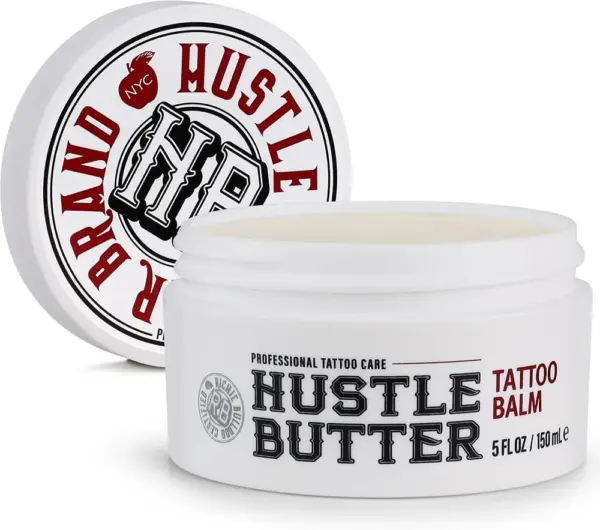
Hustle Butter Tattoo Balm – Best Overall
Key Features
- Base: Vegan, petroleum-free
- Size: 5 oz
- Scent: Scented
- Format: Balm
- Price: Midrange
Most tattoo balms arrive in a tin small enough to lose in a coat pocket. Hustle Butter comes in a 5 oz tub, and that size is the first reason it takes our top spot: a half sleeve gets balmed two or three times a day for a fortnight, and a small tin gives out halfway through. The formula is a thick, shea-based balm that spreads thin once it warms on your fingers, so a fingertip covers a palm-sized patch. It is the one we reach for first, on fresh work and on ink that is years old.
What surprised us is how it behaves under clothes. It settles into the skin rather than sitting on top of it, and it does not leave the shine on a bedsheet that a petroleum ointment does. A rich, fragrant balm is also a lot to ask of reactive skin, and this is no exception — patch test the inside of your wrist before you commit a fresh tattoo to it, and if shea and essential oils have bothered you before, start with our sensitive-skin pick instead.
The other half of the appeal is what happens after the healing is over. Worked into healed color, it lifts a flat, tired tattoo back toward how it looked in its first month, and the effect lasts until the next wash. That is why a tub stays in our cabinet when nothing is healing. One practical note: the balm stiffens in cold weather, so warm it between your fingers rather than digging at it.
Pros
- 5 oz tub covers a whole healing cycle
- Spreads thin, so a little goes far
- Works on healed ink as well as fresh
- Settles without a greasy shine
Cons
- Turns grainy if it melts in heat
The one we tell friends to buy: a big tub that covers a whole healing cycle and keeps old ink looking wet, as long as you patch test first.
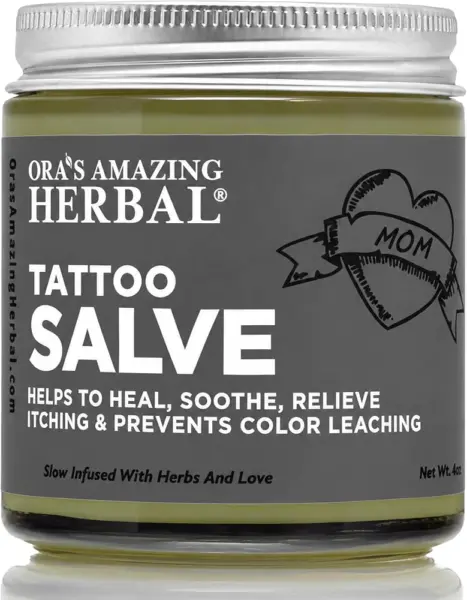
Ora’s Amazing Herbal Salve – Best for Sensitive Skin
Key Features
- Base: Plant-based, petroleum-free
- Size: 4 oz
- Scent: Light essential oil
- Format: Salve
- Price: Midrange
A rash is the thing that derails more aftercare routines than anything else. You spend the first week keeping the skin calm, then a rich balm or a heavy fragrance brings it up in bumps and you are back at the studio asking whether it was the ink or the product. Ora’s is the one we point reactive skin toward. It is a cold-infused botanical salve, petroleum-free, with no synthetic fragrance or parabens, and it is the product here we felt safest recommending to someone whose skin has already had a bad week.
We like it best in the itchy, flaking second week, when the tattoo has tightened and every sleeve feels like sandpaper. It goes on soft rather than waxy, sinks in without a film, and takes the edge off the itch quickly, which is the point where most balms start to feel like a chore. The scent is light and herbal, cool on the skin, and it fades within a few minutes, so you are not walking around smelling like a candle shop.
The trade is size. A 4 oz jar will not carry a full back piece on its own, so this is the one to buy when your skin has already told you it is fussy, not as a bulk buy. On smaller work it goes a long way — ours has been through more than one healing cycle and still has enough left for upkeep. Spot test anyway: botanical does not mean hypoallergenic, and the essential oils are still in there.
Pros
- Calm on skin that reacts to other balms
- Sinks in without a waxy film
- Light herbal scent that fades
Cons
- Costs more per ounce than our top pick
The pick for skin that has broken out on richer balms: a botanical salve that calms the itch without leaving a film behind.
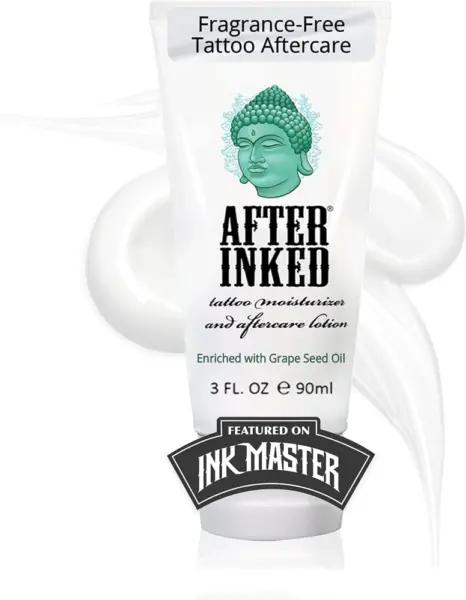
After Inked Tattoo Lotion – Best Lotion for Daily Wear
Key Features
- Size: 3 oz
- Format: Lotion
- Fragrance: None added
- Key ingredient: Grape seed oil
- Price: Midrange
Not everyone wants to wear a balm. If you work with your hands, wear long sleeves, or sit at a desk all day, a layer of shea butter under a cuff gets old by the second morning. After Inked is the lotion answer: a grape-seed-oil cream that absorbs in seconds and leaves nothing behind. It is the one in this group we put on and forget about.
It is also the most versatile product here. The same tube is meant for permanent makeup and for skin recovering from laser removal, which makes it the one that lives in a bathroom cabinet rather than a tattoo kit. The listing describes it as free of fragrance and parabens, and it is vegan and cruelty-free, so there is very little in it for skin to argue with.
What settled it for us is the finish. Most lotions in this category either sit wet for ten minutes or dry down tight enough to feel like paper; this one lands in between, cool going on and matte once it is in. We used it several times a day on a healing forearm piece without the skin ever feeling smothered, and it never marked a white shirt. The Hustle Butter balm still does more for a dry, cracking patch, but for daytime wear this is the one we reach for.
Pros
- Absorbs fast with no residue
- Fragrance-free and paraben-free
- Also suited to permanent makeup
Cons
- Tube empties faster than a balm tub
Buy this if you want aftercare you can wear to work: it absorbs in seconds, leaves no film, and works on healed ink too.
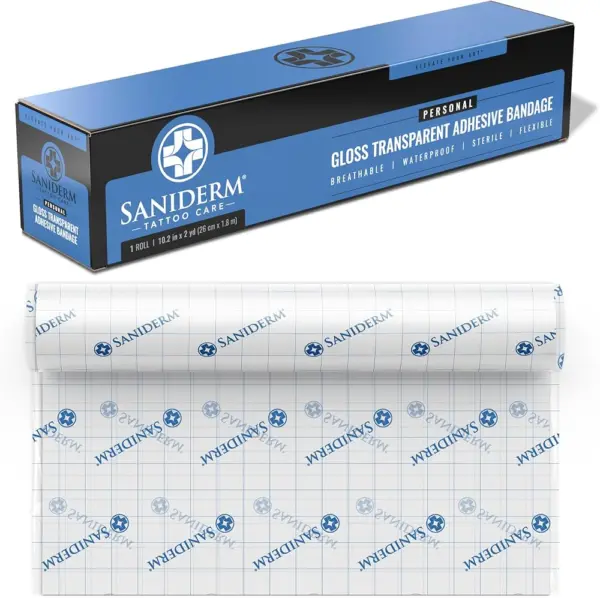
Saniderm Aftercare Bandage – Best Healing Bandage
Key Features
- Size: 10.2 in x 2 yd
- Format: Adhesive film
- Material: Sterile, latex-free
- Price: Premium
The first four days decide a tattoo. Scab it, crack it, catch it on a shirt, and you are looking at a patchy heal that no balm will rescue afterwards. Saniderm skips the balm entirely for that stretch: a clear adhesive film that seals the fresh tattoo under a sterile, latex-free sheet, so nothing touches the ink, nothing rubs, and you can shower with it on.
We understand why artists hand it out. On a placement that is hard to heal — ribs, thigh, anywhere a waistband crosses — the film removes about a week of small decisions, and what is underneath comes out flat rather than scabbed. What we do not love is how much the result depends on getting the application right. Lay it on skin that is still damp, or stretch it as you press it down, and the edges lift within a day and take the whole idea with them.
Removal is the other half of the technique. On tolerant skin the sheet holds through several showers and comes away clean; pulled dry, it takes a layer of tender skin with it. Take it off in the shower with the water running and let the adhesive give up on its own rather than rushing it.
Pros
- Keeps a fresh tattoo sealed and clean
- No ointment on clothes or sheets
- Shower-safe once it is on
Cons
- Air pockets take practice to avoid
- Adhesive can leave a rash on sensitive skin
For awkward placements and anyone who cannot leave a fresh tattoo alone — a film that handles the first four days, provided it goes on dry and comes off wet.
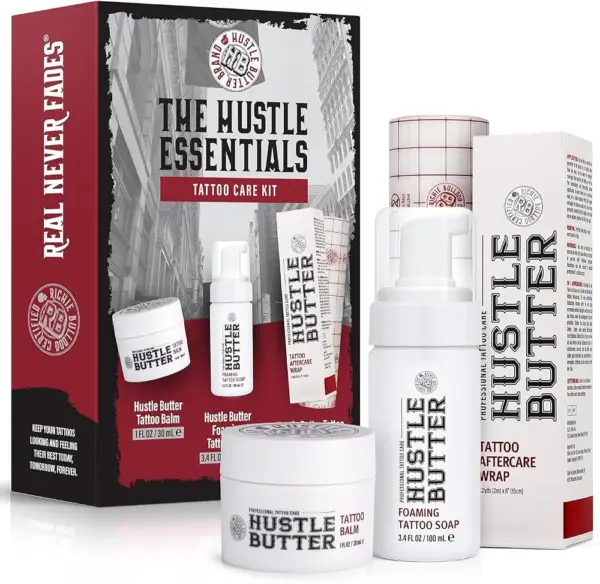
Hustle Butter Aftercare Kit – Best Kit for a First Tattoo
Key Features
- Travel: TSA-friendly
- Includes: Balm, foaming soap, wrap
- Balm size: 1 fl oz
- Price: Premium
The case for a kit is not novelty, it is not having to think. This box holds the balm we recommend at the top of this guide in a 1 fl oz size, a 3.4 fl oz bottle of the Hustle Bubbles foaming soap, and a roll of aftercare wrap, all small enough for a carry-on. For a first tattoo that is the whole first week in one purchase: wash it, balm it, cover it. We hand it to people who are about to sit for their first piece and do not want to assemble a routine from three separate orders.
The soap is the quiet star. It is a foaming pump, so you are not working up a lather against a two-day-old tattoo that stings when you touch it — you dab, rinse, pat dry. The wrap is the same idea in another form: a mess-free cover that comes off without a fight. It is also the version we take on trips, since the bottles clear carry-on limits and a weekend away mid-heal does not mean decanting balm into a contact lens case.
Pros
- Balm, wash and wrap in one box
- Sized to travel with
- Foaming wash is gentle on fresh ink
Cons
- Balm inside is the small 1 fl oz tub
A tidy first-tattoo purchase: the balm we recommend, a foaming wash and a wrap, all in one carry-on-sized box.
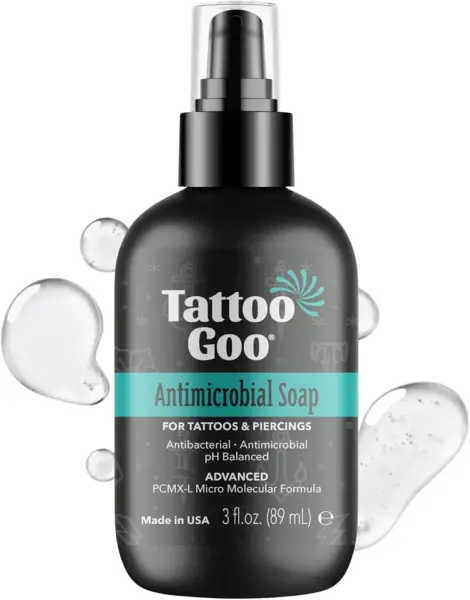
Tattoo Goo Cleansing Soap – Best Cleanser
Key Features
- Use: 2-3 times daily
- Size: 3 oz
- Format: Foaming wash
- Fragrance: None added
- Price: Budget
Washing is the step people rush. You are told to clean a fresh tattoo two or three times a day, and the default is whatever is already in the shower, which is usually a scented body wash with a long ingredient list. Tattoo Goo’s cleanser is the fix: a pH-balanced wash built on olive oil and PCMX, with no added fragrance, alcohol, lanolin or petroleum jelly.
The formula is why we keep coming back to it. It cleans without the sting a normal shower gel produces on two-day-old skin, and it does not leave the tattoo tight and dry the way a bar soap does. The olive oil base means skin feels conditioned afterwards rather than stripped, which matters when you are about to put a balm over the top of it.
Where it is less impressive is the lather. You get thin foam rather than a rich one — partly the point on raw skin, but it means working the soap between wet hands instead of squeezing it straight onto the tattoo. A small amount covers a palm-sized area, and a bottle goes the distance: ours has outlasted two balms.
Three ounces does not sound like much until you use it properly. This is one of the cheapest products here, it fixes the weakest part of most aftercare routines, and it is the one we add to a routine that is already working rather than replacing anything. If you are buying a single thing to improve how a tattoo heals, make it the wash.
Pros
- Cleans without stinging
- Does not strip or dry the skin
- A bottle lasts a full heal
Cons
- Noticeable smell despite no added fragrance
The cheapest way to fix the weakest step in most routines: a gentle wash that cleans fresh ink without stinging or stripping it.
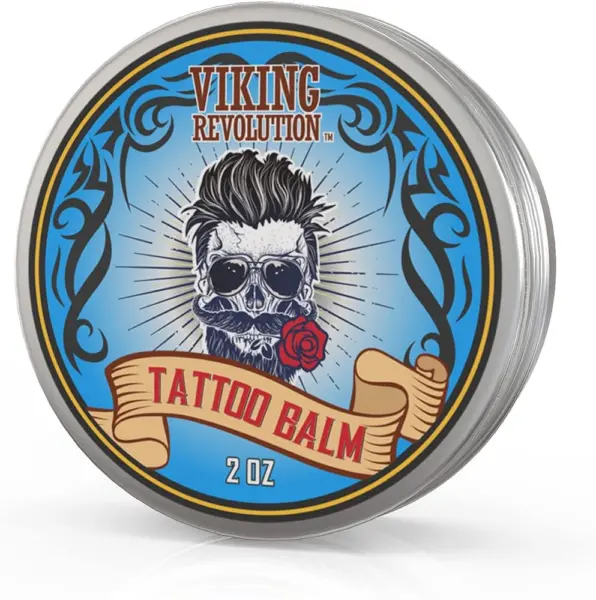
Viking Revolution Balm – Best Budget Balm
Key Features
- Use: Before, during and after
- Size: 2 oz
- Scent: Mild coconut
- Format: Balm
- Price: Budget
This is the cheapest balm in the group, and it does not behave like one. A 2 oz tin, a mild coconut smell, a firm balm that melts on contact — nothing about it announces a budget product, and the tin is small enough to keep in a bag without thinking about it.
It is built to be used before, during and after a session, which is why it turns up in studio kits as well as bathroom cabinets. On healed ink it does the thing most balms here claim: it brings color back up, so grey-green lines read closer to black for a day or two. On a fresh piece it moisturizes well and sits lightly under a shirt without the greasy residue that makes people give up on balms.
Two ounces is the smallest full balm tub here, and on a large piece you will notice it. That is the trade for the price: buy two if you are healing a back piece, or keep it for smaller work where a tin lasts a season.
The thing to know before you buy is that the formula does not suit every skin. Small bumps around the edge of a tattoo are the reaction to watch for, and they tend to show up in the first few applications rather than weeks in. If scented balms have been fine for you, this is the one we point to when someone wants a proper balm without spending much. If they have not, spend more on the Ora’s jar and skip this.
Pros
- Cheapest balm here
- Mild coconut scent
- Brings color back to old ink
- Non-greasy under clothes
Cons
- Clothing rubs it off before evening
The budget entry: a mild, non-greasy balm that brightens old color, provided your skin has been calm with scented balms.
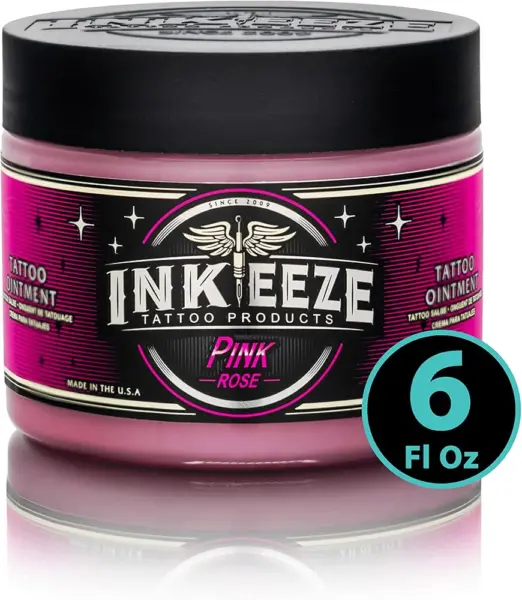
INK-EEZE Pink Ointment – Best for Large Pieces
Key Features
- Base: Non-petroleum
- Size: 6 oz
- Scent: Bubble gum
- Format: Ointment
- Price: Midrange
INK-EEZE smells like bubble gum. Not faintly — the whole jar, every time the lid comes off. That is either the reason you buy it or the reason you put it back on the shelf, and it is worth knowing before you smear it on a healing tattoo.
Under the scent it is a serious product. It is a non-petroleum ointment built on safflower and tamanu oils with beeswax, royal jelly and propolis, made for studio use during a session as much as for aftercare at home, and the 6 oz tub is the largest container in this group by a distance. A thin coat covers a lot of skin, so the thing lasts.
We reach for it on a large piece where economy matters most, and we think twice on anything small and delicate. It is thick and slow to sink in, and the bubble gum is exactly the kind of fragrance sensitive healing skin objects to — if a scented balm has ever brought you out in bumps, this is not the one to test the theory on. On a big, sturdy placement, though, the tub keeps going long after a small tin would have run out.
Pros
- 6 oz tub lasts a long time
- Thin coat covers a large area
- Built for studio use as well as aftercare
Cons
- Melts to liquid in a warm room
One for people who like a scented ointment and a big tub: studio-grade, economical on large pieces, and unapologetically bubble gum.
How We Tested Tattoo Aftercare
We started by asking working artists which formulas they actually send clients home with, then read every ingredient list and compared cost per ounce, since a tin that lasts three days is not a bargain at any price. From that pool we bought 14 products across three formats (balm, lotion, and ointment) and both scented and unscented versions, so we could judge fragrance on its own rather than guessing.
Each product was used on real healing tattoos at every stage, from the weeping first evening through the flaky second week. We applied a thin layer twice a day, waited ten minutes, then pressed a tissue against the skin to see how much product came off, which told us more about stickiness than any label could. One tester with reactive skin patch-tested each formula on the inner forearm for two days before letting it near ink. We also noted how a layer held up through a workday, a gym session, handwashing, and a night between cotton sheets.
Every few days we photographed each tattoo in the same window light to compare how saturated the color stayed and whether the lines healed sharp or soft. We logged sting on application, redness in the surrounding skin, whether flaking stayed fine or turned to thick scabbing, and how strongly each scent lingered after it dried. Finally, we tracked how long a full-size container lasted at twice-daily use, which is where value for money really shows up.
How to Choose Tattoo Aftercare
The right aftercare is less about finding a miracle balm than matching three things — format, fragrance load and how much skin you are covering — to the week you are actually having.
Match the product to the stage, not the label
The first three to five days and the fortnight after them want different things. Early on the job is keeping the tattoo clean and covered: a dedicated wash and, if your artist uses one, a healing film. Once the skin tightens and starts to flake, it is all about moisture — a balm for dry, cracking patches, a lotion if you want something you can wear under clothes all day. Most disappointing routines come from buying one product and asking it to do all three jobs.
Healed ink is a third stage and the easiest one to skip. A balm worked into old color brings it up for a day or so, which is why both our top pick and the budget balm here earn a place in a bathroom cabinet rather than a tattoo kit.
Fragrance and botanicals are where reactions start
Nearly every balm in this category smells of something, and the scent is usually essential oils — the same oils that can bring sensitive skin up in bumps around the edge of a tattoo. Natural and plant-based are not the same as hypoallergenic. If your skin has reacted to a scented product before, start with a fragrance-free lotion or a plain salve and spare yourself the week.
The test is simple: a small amount on the inside of your wrist or behind your ear, twenty-four hours before it goes anywhere near the tattoo. A reaction there is a reaction you have avoided.
Buy for the area you are actually covering
Container size is the number people skim past. A balm goes on two or three times a day for a fortnight, so a palm-sized tattoo will barely touch a 5 oz tub while a half sleeve will get through a small one. Match the container to the piece: a travel tin for a first small tattoo, a full tub for anything bigger than a hand.
The same logic applies to how the product behaves once it is open. Balms soften in a warm bathroom and turn grainy if they get properly hot, so a big tub kept somewhere cool beats a small one left in a car.
Films and wraps are technique as much as product
A healing film can remove a week of decisions, but only if it goes on dry skin, in one piece, without stretching. Air pockets and lifted edges are application problems rather than product failures, and they are the reason people give up on films after one attempt.
Take it off in the shower with warm water running rather than pulling it dry, and if medical tape has ever left you red, test a short strip somewhere else before you wrap a whole tattoo.
Frequently Asked Questions
How often should I put aftercare on a new tattoo?
Follow your artist’s instructions first — they know the piece and how it was worked. As a general guide, the labels here suggest a balm or wash two to three times a day and a lighter lotion three to four. Thin is the rule: if the skin looks shiny or wet when you have finished, you have used too much, so blot the excess with a clean paper towel.
Can I use petroleum jelly or my regular body lotion instead?
Petroleum jelly is the old studio default, but it is heavy and occlusive, which is why every balm in this guide is petroleum-free. A plain, fragrance-free body lotion is a reasonable stand-in once the tattoo has stopped weeping; on two-day-old ink, use something built for it. Whatever you reach for, read the label for fragrance and alcohol before it touches the tattoo.
What does an infected tattoo look like, and when should I stop using aftercare?
Aftercare handles dryness, itching and flaking — it does not treat infection. Spreading redness, warmth, swelling, a yellow or green discharge or a fever needs a doctor or your artist’s advice, not another balm. Stop applying products to the area, keep it clean and dry, and get it looked at the same day.
Final Verdict
The default is Hustle Butter. A 5 oz tub, a balm that spreads thin, and enough staying power to carry a large piece through the tight, itchy week — that is the whole argument, and it has not changed.
If your skin has reacted to a balm before, the Ora’s salve is the safer first buy. If the placement is awkward or you want four days of not touching it at all, Saniderm takes the decisions away. Everything else here is a variation on those three jobs: cleaning it, wearing it under clothes, and doing it cheaply.