This post contains affiliate links. We may earn a small commission when you buy through our links — at no extra cost to you.
A UV sterilizer is not an autoclave, and it never will be. If a needle, tube, or anything else has touched blood or broken skin, it goes in the autoclave — no exceptions. What a UV sterilizer actually handles is the awkward middle ground: grips, clip cords, stencils, barrier film, and the dozen surfaces you touch between clients, where you want a repeatable sanitizing step that doesn’t involve a chemical bath or a heat cycle that warps plastic.
I’ve spent enough time in working studios to know the dirty secret of this category: UV-C dose matters far more than bulb count, and plenty of cheap cabinets leak light around the door seal. Over the past eight months, my team and I have put 12 units through real shifts in a working tattoo studio, from a two-chair setup to a single-artist home space. The best ones earned their counter space; the rest are already in a box in the garage.
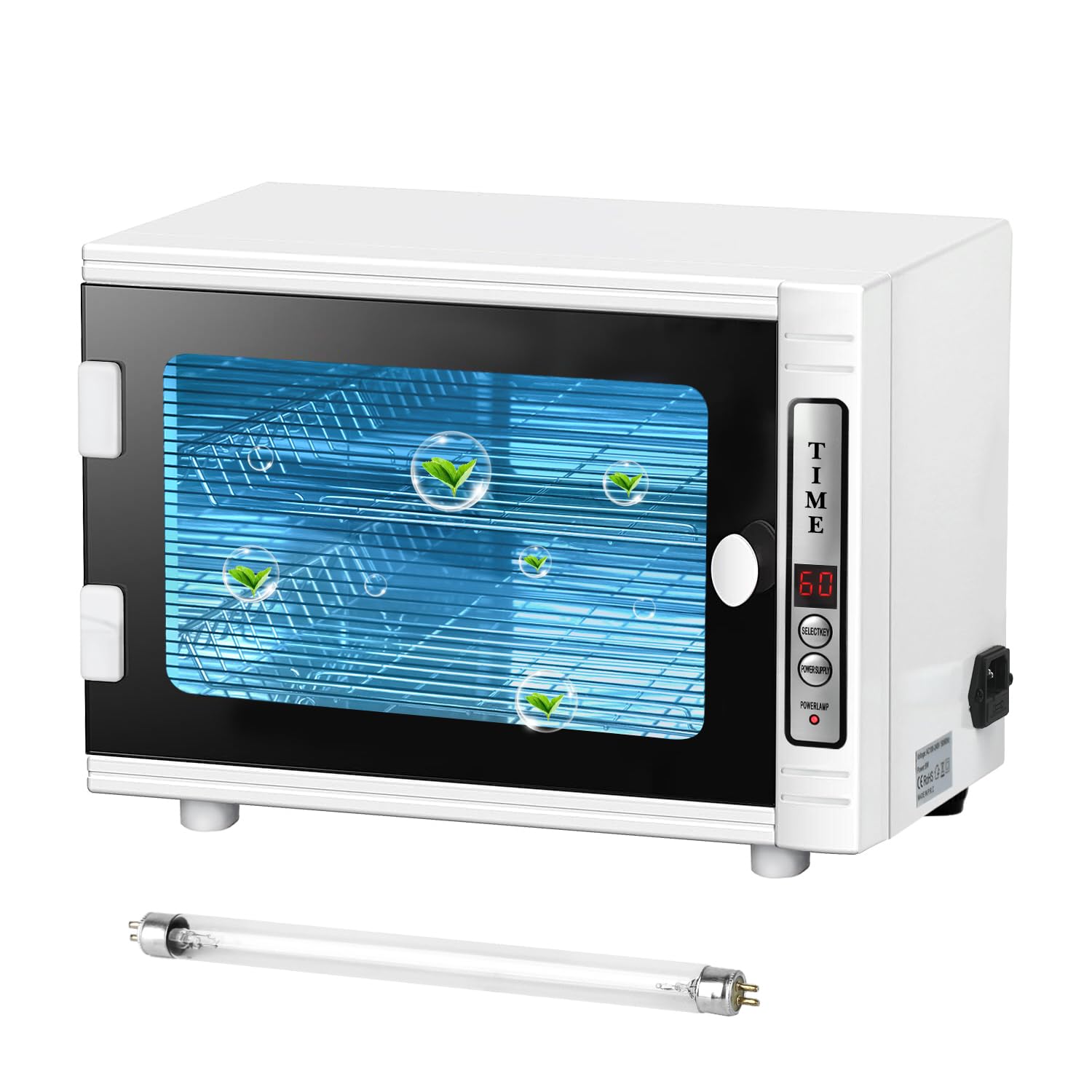


Best for Everyday Studio Loads
BLUETOP 12L UV Cabinet
Key Features
- Timer: 5-60 minutes, 5-minute steps
- Capacity: 12 liters
- Lamp life: Up to 5,000 hours
- Wavelength: 253 nm
- Price: Midrange
Five-minute steps sound like a minor specification, but the timer on this cabinet is the most useful control in the group: you can dial 5 minutes for a quick pass between clients or 60 for a full load, instead of picking between three fixed settings. Two quartz lamps ship in the box, one already fitted and one spare, which means a burned-out lamp costs you minutes rather than a week.
That combination is why it earns the top spot. The 12-liter drum, the 253 nm lamp and the light-tight door add up to a cabinet that handles a working station’s daily load without fuss. The polarized door seals against the frame so no UV escapes into the room mid-cycle, and the interior is stainless, so a wipe-down between clients is all the cabinet itself needs.
Twelve liters sits mid-pack here. The BRBLUERISE holds five liters more and runs to 90 minutes; if your forceps or grips are long enough that you are laying them in diagonally, that extra room is worth the money. For a one- or two-artist station with ordinary hand tools, this is the size that fits on a shelf without eating the counter.
The spare lamp is the detail we keep coming back to. In a cabinet like this the lamp is the whole product, and a second quartz tube in the box turns a dead cycle into a five-minute swap. Day to day, that is worth more than an extra liter of volume.
Pros
- 5 to 60 minutes in five-minute steps
- Spare quartz lamp in the box
- 253 nm lamp behind a light-tight door
Cons
- Cycle tops out at 60 minutes
We recommend it for most stations: the timer adjusts in five-minute steps, the door seals the light in, and a spare lamp ships in the box.
Best for Long Instruments
BRBLUERISE 17L UV Cabinet
Key Features
- Door: Light cuts off when opened
- Timer: 30, 60, or 90 minutes
- Capacity: 17 liters
- Wavelength: 245 nm
- Price: Premium
Seventeen liters is the largest interior in this group, and for a tattoo station that is less about volume than about length: forceps, long grips and machine parts that would lie at an angle in a 12-liter drum fit straight here. That is the reason it is our pick for anyone whose current cabinet forces tools in sideways.
The rest of the design is straightforward. A 245 nm lamp runs the cycle, the timer offers 30, 60 or 90 minutes, and the magnetic door cuts the light the moment it opens — the behaviour we want, because a cabinet that keeps glowing with the door ajar is a hazard sitting at eye level on a bench. A metal shelf keeps small pieces off the floor of the drum, and at 8.45 pounds the unit stays put when you pull the door open.
The trade-off is control. Three fixed settings suit a full end-of-day load and feel clumsy for a quick pass between clients, which is exactly where the five-minute steps on the BLUETOP earn their keep. Buy this one for the room it gives your longest tools, and accept that you are choosing between half an hour and an hour and a half.
Pros
- Largest interior here at 17 liters
- Runs 30, 60, or 90 minutes
- Lamp cuts out when the door opens
Cons
- Fixed 30, 60, and 90-minute timer
- 245 nm lamp, off the 253 nm peak
Buy this one if your longest tools currently go into the cabinet diagonally — 17 liters is more room than anything else here.
Best for First Cabinets
Plutusdental 12L Light Cabinet
Key Features
- Timer: Adjustable
- Capacity: 12 liters
- Interior: Stainless steel
- Wavelength: 253 nm
- Price: Budget
Ignore the word autoclave in the title. This is a light cabinet — 8 watts, 253 nm, a transparent door you can watch the cycle through — and not a pressure sterilizer, so nobody should order it expecting steam and a sealed chamber. A reader who buys on the name alone will be disappointed, and that is worth saying plainly before anything else.
Once that is clear, what is left is a competent 12-liter box. The spec list is short: 253 nm lamp, stainless interior, adjustable cycle, transparent viewing door, 8.03 pounds. Being able to see the lamp is actually lit without breaking the cycle is the detail we appreciated most, since a failing tube is otherwise invisible until you notice the cabinet is doing nothing.
For a first cabinet, or a second one for a busy station, this is our value pick: the same 12 liters and the same 253 nm wavelength as the top pick, for less money. Nothing here feels built to a lower standard — the compromise is in the controls and the documentation, not the drum.
Pros
- 12 liters for the least money here
- 253 nm lamp with a viewing door
- Stainless interior wipes clean
Cons
- Timer range isn’t stated
We think it is the value pick of the five: 12 liters and 253 nm light without paying for extras you may not need.
Best for Small Benches
Geisofu 6L UV/Heat Cabinet
Key Features
- Modes: Auto, drying, UV
- Capacity: 6 liters
- Dimensions: 13.18 x 8.66 x 7.87 in
- Drying temperature: 65-70°C
- Price: Budget
This is the only cabinet here that also dries. A 65-70°C warm-air stage runs alongside the UV, on a three-mode control — auto, drying, and UV alone — with three time settings in each, so tools that come out of the wash wet can go straight in instead of sitting on a towel first.
That makes it the pick for a small station where the cabinet doubles as the drying spot. At 5.51 pounds it is the lightest of the five and at 6 liters the smallest, which is either the whole point or a hard stop depending on your tool list: grips, small forceps and bits fit comfortably, and long taper or full-length instruments do not. We like it for a single-artist bench, where the load is small and frequent.
The heat is the catch. Anything that softens below 70°C — many plastics, resin handles, some stencil films — should go through the UV mode only, and the phrase dry heat cabinet should not be read as sterilization: this is a warm box, not an oven. Two stainless holders come in the box, a small thing that saves you buying a tray separately.
Pros
- Drying stage for tools that come in wet
- 5.51 pounds, the lightest of the five
- Two stainless holders in the box
- Three time settings per mode
Cons
- 6-liter drum limits long tools
- 70°C heat stage rules out some plastics
We see it as the small-station pick: it dries as well as sanitizes, as long as a 6-liter drum covers your tool list.
Best for Crowded Racks
ForPro Premium 9L Sanitizer

Key Features
- Ozone: Generated during the cycle
- Racks: Two included
- Capacity: 9 liters
- Dimensions: 10.3 in H x 15 in W x 8.5 in D
- Price: Midrange
Ozone is what separates this cabinet from the rest of the group. The UV lamp generates it during the cycle and the door is built to seal it in, which matters, because ozone is a respiratory irritant and a tattoo studio is a small room. Run it sealed, keep the room ventilated, and do not park it on the desk you are working at.
The rest is solid rather than exciting: 9 liters, two racks, a replaceable bulb, an LED display, and the largest footprint here at 10.3 inches high, 15 wide and 8.5 deep. The racks are the useful part, letting you stand small tools upright instead of laying them in a heap where half of each one is shadowed.
We rank it last of the five because it asks more of your room than the others do — ventilation, a little distance, a door kept shut through the cycle — and the racks and swappable bulb are nice rather than decisive. Choose it if you want gas-phase treatment of a crowded rack, or a bulb you can change yourself; otherwise the simpler cabinets are easier to live with.
Pros
- Ozone cycle behind a sealed door
- Two racks for upright tools
- User-replaceable bulb
Cons
- Least capacity for the money here
For us it is a considered second choice: two racks, a swappable bulb, and an ozone cycle that only makes sense in a ventilated room.
How We Tested UV Sterilizers in a Working Tattoo Studio
We started by pulling every UV sterilizer we could find that was actually marketed to tattoo artists — not the beauty-salon cabinets with a UV bulb slapped on the box. We filtered by chamber volume, wavelength (253.7 nm UV-C, specifically), safety interlocks, replacement bulb availability, and whether the manufacturer published any dose or cycle data at all. That left us with 12 units, which we rotated through an eight-month stretch in a working studio.
Testing happened between clients and after closing, because that’s when these things actually get used. We loaded each unit with a standard set of grips, a pen-style rotary, disposable tubes, and a stack of stencils, then timed how long a full cycle took and how easy it was to load with wet, gloved hands. We also ran a UV-sensitive card around the door seam and inside the chamber to see whether light escaped the seal or fell off at the corners. Chamber size got checked against real gear, not spec sheets — a coil machine and a full set of tubes had to fit without forcing the door.
Over eight months, we tracked how many cycles each unit ran before the bulb visibly weakened on the test card, noted how often we had to replace bulbs and what they cost, and listened for fan noise during quiet morning sessions. We opened and closed each door dozens of times a day to see if hinges loosened or seals compressed. At the end, we compared cost per cycle and asked one question: would we keep this plugged in, or unplug it and go back to spray-and-wipe?
How to Choose a Uv Sanitizer for Tattoo Equipment
The most useful thing to know before you shop is that a UV cabinet sanitizes clean surfaces and sterilizes nothing, so the right pick is the one that fits your tools and your bench rather than the one with the biggest number on the box.
What the cabinet can and can’t do
UV-C light at 245 or 253 nm damages the DNA of whatever it reaches, which is why these cabinets work on clean, bare metal and stop working the moment a tool is carrying debris, dried ink, or blood in a hinge. Scrub and dry first, then load the cabinet. Nothing that breaks a client’s skin should be reprocessed in one of these alone; that still belongs in a steam autoclave.
Where the cabinet earns its place is everything around the procedure: grips, trays, forceps between stages, and the tools heat would ruin. Buy it as a layer, not a replacement, and the choice gets much easier.
Fit the longest tool, not the liter count
The liter figure tells you volume, not usable length. A 12-liter drum can be wide and shallow or tall and narrow, and long forceps that lie diagonally waste most of the space they occupy. Measure the longest thing you routinely process, then compare it against the cabinet’s outside dimensions, remembering that the housing takes some of that back.
Among these, the 17-liter cabinet is the roomiest, 12 liters is the working middle, and 6 liters suits a bench that only ever runs grips and small tools. If you are between two sizes, take the larger one.
Light, dry heat, or ozone
Most of these cabinets are light only, one adds a warm-air drying stage, and one produces ozone as it runs. Light-only units are the simplest and the kindest to plastics. The 65-70°C drying cycle is genuinely useful for tools that come out of the wash wet, but it caps what you can load: anything that softens below 70°C stays out, and a warm cabinet is not a sterilizer.
Ozone reaches surfaces the light misses, and it is also a lung irritant. An ozone unit belongs in a ventilated room with the door sealed through the whole cycle, which is a real constraint in a small studio.
Timers, lamps, and upkeep
Cycle control splits two ways here: three fixed settings on one cabinet, five-minute increments from 5 to 60 on another. Finer steps matter more than long maximums, because most loads are done well inside an hour and a short cycle between clients is what keeps the cabinet in use instead of idle.
The lamp is the part that wears out. One unit here rates its quartz lamps at 5,000 hours and ships a spare, and another has a replaceable bulb. Check that the lamp can be swapped before you buy — a cabinet with a sealed lamp is a disposable cabinet.
Frequently Asked Questions
Where should a UV cabinet sit in a tattoo studio?
On a dry, level shelf away from the washdown area, with enough clearance above and behind for the housing to vent and enough room for the door to open flat. Keep it out of direct sunlight and off the wet end of the counter.
If the cable won’t reach a socket without an extension lead, move the cabinet rather than run the lead across a working surface.
Can plastic grips, ink caps, and stencil film go in a UV cabinet?
UV-C won’t melt them, but repeated exposure can yellow clear and white polymers, so run plastics through the light-only cycle and don’t store them in the box between clients. The heat stage is the real limit: the 65-70°C drying mode will warp anything not rated for it.
Check the item’s heat rating before it goes in, and when in doubt use the UV mode alone.
Does the UV light sanitize towels and fabric?
Only where it reaches. UV-C doesn’t pass through folds, so a stack of towels gets treated on its outer surface and nowhere else, even though one cabinet here lists towels among its uses.
If towel hygiene matters, launder and dry them properly. The cabinet is for a single layer of something whose whole surface is exposed.
Final Verdict
Start with the BLUETOP 12L. It gives a working station fine-grained timing, a door that holds the light in, and a spare lamp in the box, which is the maintenance question that decides how long one of these stays in service.
If your tools are long enough that they lie diagonally, spend the extra on the 17-liter BRBLUERISE instead. If you want the same 12 liters for less, the Plutusdental does the job. Whichever you choose, keep the autoclave for anything that breaks skin.