This post contains affiliate links. We may earn a small commission when you buy through our links — at no extra cost to you.
Halfway through a lining session, with both gloves inked and a client holding still, you reach for a wash bottle without looking — and that’s when a bad one announces itself. One that won’t crack open one-handed, or that’s been seeping into your tray since morning, turns a two-second rinse into a cleanup. A good bottle puts a controlled stream of water or green soap exactly where you point it, session after session, without soaking the fresh linework or the client’s arm.
I’ve worked with everything from repurposed lab bottles to soft silicone squeezers, and my team spent the past four months putting 14 of them through real appointments. The thing that surprised me: nozzle design matters far more than capacity. A bottle that holds 16 ounces is great until it’s too stiff to control with a gloved hand. The picks below are the ones that kept earning a spot on the station — and the ones I stopped dreading reaching for.
Our Top Picks
The Best Tattoo Wash Bottles, Reviewed
Melphoe Wash Bottle 2-Pack – Best Overall
Key Features
- Care: Hand wash
- Nozzle: Bent, narrow tip
- Capacity: 500 ml
- Pack size: 2 bottles
- Price: Midrange
Two 500 ml bottles in one pack is the detail that decides this for us. A station needs two liquids — distilled water for the rinse and diluted green soap for the wash — and buying them as a pair means you set both up once and never swap caps mid-piece. The bent neck and printed scale on each bottle then do the small, constant work: aim, squeeze, refill, repeat.
The nozzle is where a wash bottle earns or loses its place on the tray. This one holds a thin, even stream rather than a gulp, so you can rinse along the edge of a fresh line without chasing water across the whole area. The LDPE body is soft enough to feather with a gloved hand, which sounds like a minor thing until you have spent a session fighting a stiff bottle.
Printed scales run up the side. Green soap often gets mixed by eye, and a marked bottle at least keeps the ratio close from one batch to the next. The body wipes clean without much fuss, the cap comes off for a refill without a fight, and having two means one can be soaking while the other is in use.
The cap deserves one note: it seals well in normal use, but fill past the shoulder and you will find a bead of liquid in the threads the first time you tip it. Keep it under the fill line and it stays dry. For a two-chair studio, a second pack gives you four bottles and a clean split between rinse water, soap and spares.
Pros
- Two bottles split rinse water and soap
- Bent nozzle aims without tipping
- Printed scale keeps soap batches repeatable
- Soft LDPE body feathers easily
Cons
- Draw tube can split at the cap
Our pick for most tattoo work: two 500 ml bottles, a bent nozzle that puts the rinse exactly where you aim it, and printed scales that make a batch of green soap repeatable.
UPTATSUPPLY Wash Bottle 3-Pack – Best for a Full Station Setup
Key Features
- Care: Hand wash
- Nozzle: Angled neck, trimmable tip
- Capacity: 500 ml
- Pack size: 3 bottles
- Price: Midrange
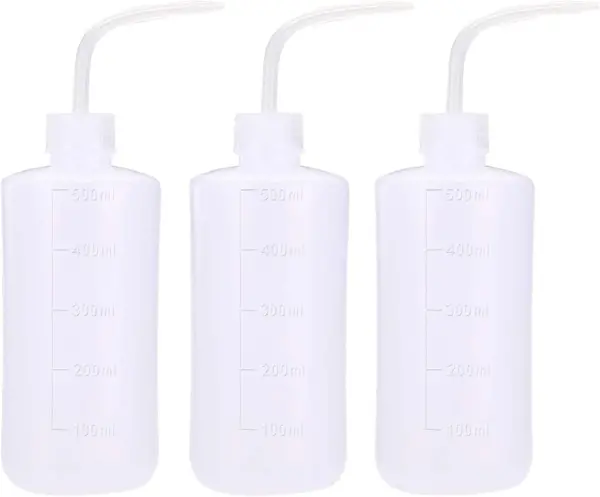
Three 500 ml bottles arrive together, which is more than a solo artist strictly needs and exactly right for a working station. One holds the final rinse, one holds green soap, and the third stays charged as a spare or a second mix — no decanting, no rinsing a bottle out between steps.
We think the angled neck is the reason to pick this set over the cheaper two-packs. It points down and away from the cap, so you can hold the bottle beside the client’s arm rather than above it and still land the stream on the line you are rinsing. The narrow opening keeps the flow tight, and it is designed to be cut back if you want a faster flood for a large piece.
The body is a Boston round with a short neck: stable on a tray, comfortable in the hand, quick to fill. The LDPE has the soft, springy squeeze we look for in a bottle that gets used every hour. It is hand wash only, and the white finish will pick up ink and soap scum over a few months, which is cosmetic rather than a failure.
Pros
- Three bottles cover water, soap and a spare
- Angled neck reaches without tipping
- Tip can be widened for a faster flow
Cons
- A trimmed tip cannot be narrowed again
We recommend this three-pack for anyone running several solutions at one station; the trimmable tips let you set one bottle for a faster flood and keep another tight.
HOOMBOOM Wash Bottle 2-Pack – Best for Fine Detail Work
Key Features
- Care: Hand wash
- Nozzle: Narrow tip
- Capacity: 250 ml (8 oz)
- Pack size: 2 bottles, white and black
- Price: Budget
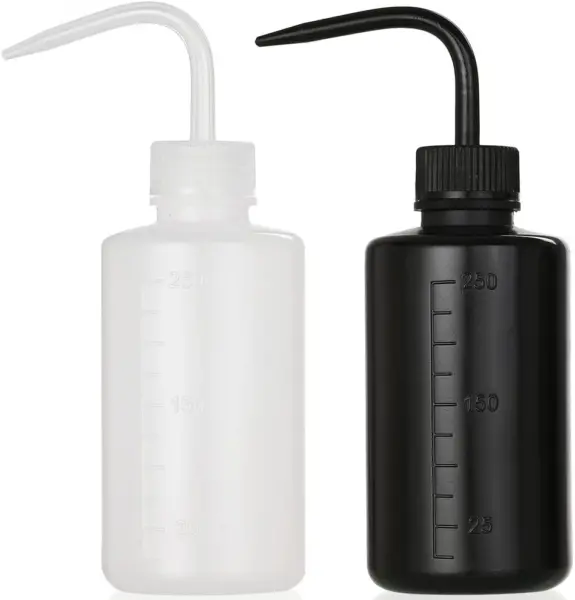
One pair, two colors. White goes to rinse water, black goes to green soap, and the labelling problem solves itself, because nobody has to squint at a bottle in the middle of a piece. It is a small thing that turns out to be a daily one.
At 250 ml it is the smallest bottle in this group that still works as a primary, and in the hand that is the point. The body is soft, the nozzle is slim, and the stream stays narrow — enough to rinse a short line or a tight spot without sluicing the surrounding skin. The squeeze is progressive rather than all-or-nothing, which is what makes small corrections possible.
We reach for this pair when the work is fine: liner details, small lettering, a guest artist sharing the tray. The scale markings along the body stay legible against both finishes, so a small batch of soap does not turn into guesswork. And the black bottle looks tidy beside a machine in a way clear plastic never quite manages.
Pros
- White and black keep solutions apart
- Soft body with a progressive squeeze
- Scale markings stay legible
Cons
- 250 ml needs refilling mid-session
We reach for this pair when the work is small: 250 ml, a soft body, and a narrow stream that stays where you put it.
Valchoose 1000 ml Wash Bottle – Best for Fewer Refills
Key Features
- Care: Hand wash
- Nozzle: Angled neck
- Capacity: 1000 ml
- Pack size: 1 bottle
- Price: Midrange
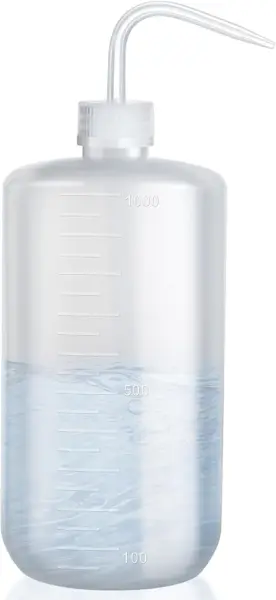
Twice the capacity of the 500 ml bottles here, and on a full day that is the difference between one refill and four. A liter also means you stop rationing: rinse as long as the piece needs instead of cutting the wash short so the bottle lasts.
We keep this one for long sessions, where the interruption costs more than the weight. A full liter is heavy in the hand and slower to bring up to eye level, so it is not the bottle for a quick touch-up or fine detail. Fill it halfway for those jobs, top it off before a big piece, and it handles like a 500 with more headroom.
The angled neck and printed scale follow the same recipe as everything else here, and the seal is better than most of this group: the cap holds when the bottle is tipped or laid on its side, which matters for something that lives on a tray between clients. Hand wash only, like the rest of these.
Pros
- Liter capacity cuts refills
- Cap holds when the bottle is tipped
- Angled neck for precise aim
Cons
- Draw tube can split at the joint
We keep this one for long sessions, when stopping to refill costs more than the weight of a full liter in your hand.
Grosun Wash Bottle 4-Pack – Best for Color-Coded Setups
Key Features
- Care: Hand wash
- Nozzle: 85-degree bend
- Capacity: 250 ml
- Pack size: 4 bottles
- Price: Midrange
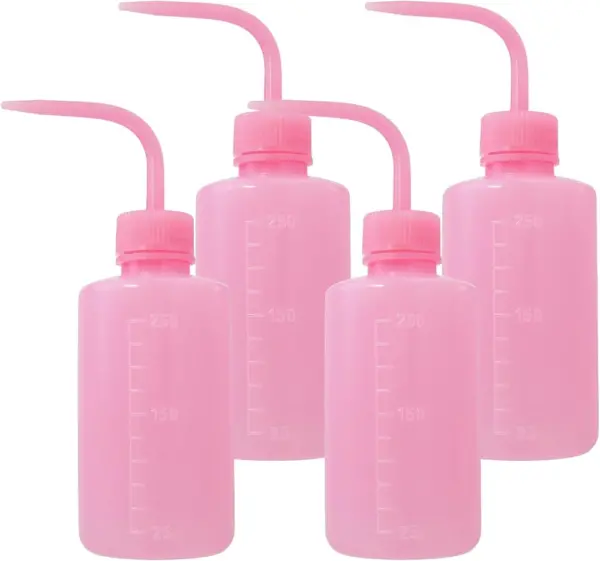
An 85-degree bend at the spout is the detail that makes this set useful: you can angle the stream down into a stencil edge or up under a wrist without tipping the bottle far enough to send water into the cap. Four 250 ml bodies, each with a marked scale, and enough of them that every solution gets its own.
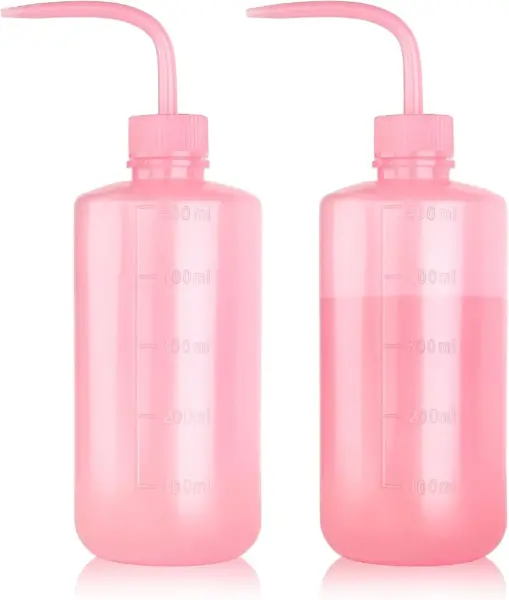
The base is molded with a concave center, which keeps the bottle standing when you set it down mid-rinse instead of rolling across the tray, and that is a design decision we noticed every time we put one down. The bend is fixed, so you aim with your wrist rather than the tip; it stops being an adjustment after the first piece. The pink is bright enough that nobody will mistake it for a lab bottle.
Pros
- Four bottles for color-coding
- 85-degree bend reaches awkward angles
- Concave base keeps it standing
Cons
- Small bottles run dry quickly
Four bottles, four solutions, no switching: the set we suggest when a station needs water, soap and a spare within reach.
ACM Economy Wash Bottle – One-Bottle Replacement
Key Features
- Care: Hand wash
- Nozzle: Angled stem, trimmable
- Capacity: 8 oz
- Pack size: 1 bottle
- Price: Budget
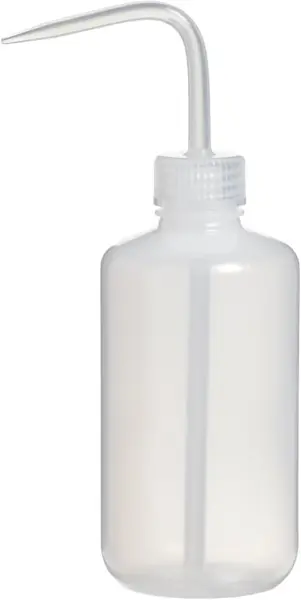
Plenty of wash bottles arrive in pairs; this one arrives alone, which is either the reason to buy it or the reason to look elsewhere. If you have three bottles on the tray and one has gone cloudy or lost its tube, replacing exactly one is the tidy move.
The design is the lab standard: a Boston round LDPE body, a polypropylene screw cap with the angled stem and draw tube molded in one piece, and a spout you can trim back if the stock trickle is too slow. The squeeze is soft and predictable, which is why this shape keeps getting copied.
The seal is the part to manage. Upright on a tray it is fine; laid on its side under a full load, liquid can work past the threads and leave a ring underneath. Keep it standing between passes and the issue does not come up.
Where it earns a place: as a spare, a travel bottle, or the one you hand a guest artist. It is inexpensive, it is the right shape, and if the tube eventually gives out you have lost a bottle rather than a set. It just should not be the only bottle you own.
Pros
- Sold singly for one-for-one replacement
- Spout trims back for more flow
- Soft, predictable squeeze
Cons
- Draw tube can split and stop drawing
It is the bottle most of us have used at some point: cheap, sold singly, and fine for the rinse, though the draw tube is the part that quits.
DERSTRA Wash Bottle 2-Pack – Best for Dark Tray Setups
Key Features
- Care: Hand wash only
- Nozzle: Bent nose
- Capacity: 250 ml
- Pack size: 2 bottles
- Price: Budget
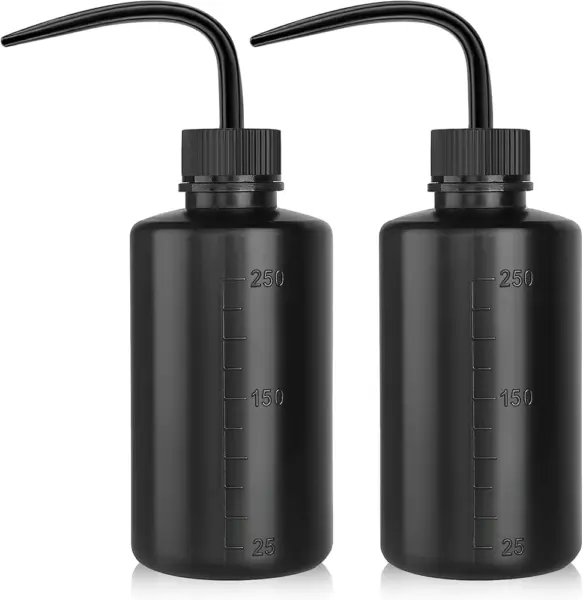
Black is the reason to choose this pair over the clear bottles here. Green soap leaves a film that makes clear plastic look grubby within a week; a black body just looks like a black bottle, and on a dark tray it reads as part of the setup instead of a lab supply.
The rest is the standard recipe done properly: an LDPE body, a bent nose, 250 ml, and a screw cap with a draw tube. The bend does the work, because you can point the stream down the side of a wrist or into a ditch without tipping the bottle far enough to send water into the cap.
We like this pair as the one that stays on the station: two bottles, one for water and one for soap, in a finish that does not show its age. Keep it to hand washing and out of direct sunlight, as LDPE prefers, and it stays a good-looking bottle rather than a cloudy one.
Pros
- Bent nose reaches tight angles
- Black finish hides soap staining
- Two bottles split water and soap
Cons
- Black body hides the water level
We like this pair for a dark tray: the black body ignores green soap stains and the bent nose still puts water where you point it.
DONSTRAW Wash Bottle 2-Pack – Easy Cleanup
Key Features
- Care: Dishwasher safe
- Nozzle: Narrow mouth
- Capacity: 250 ml
- Pack size: 2 bottles
- Price: Budget
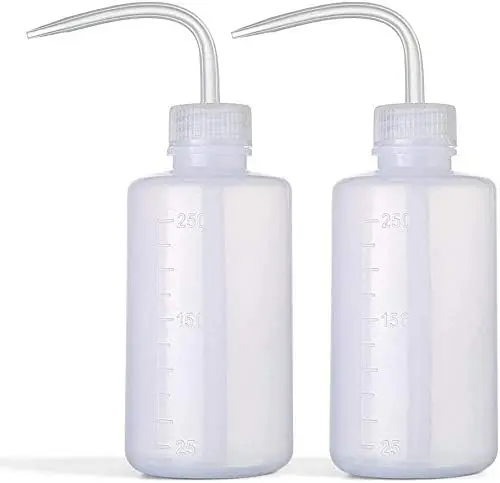
Dishwasher safe is the line that stands out, because nearly every bottle in this group is hand wash only. Green soap residue comes off in the machine instead of in the sink, and for a studio that wants a hard reset between clients, that is a real convenience rather than a bullet point.
The rest is conventional and works: LDPE body, narrow mouth, a printed scale, and a screw cap with a molded draw tube. The squeeze is soft and the tip lays down a controlled line of water rather than a splash, which is what you want anywhere near a fresh outline.
Two bottles is the right number. One sits on the tray with rinse water, the other stays in the cupboard with a fresh batch of soap, and nobody decants anything mid-session. The clear body also means you can see at a glance whether it is time to refill, which is trivial until you are mid-piece with a bottle that is down to fumes.
For a first station, this is the pair that makes the most sense: the dishwasher rating takes the worst chore off the list, and the squeeze is gentle enough for an unpracticed hand. Experienced hands may want the 500 ml bodies for the extra volume, but nobody’s first bottle should be fussy.
Pros
- Rated dishwasher safe
- Clear body shows the fill level
- Controlled stream from the narrow tip
Cons
- Cap can weep when squeezed hard
- Body can crack if dropped
Cleanup is where this pair wins for us: it is the only set here rated for the dishwasher, and the squeeze is soft enough for a long rinse.
How We Tested the Best Tattoo Wash Bottles
We started by gathering every wash bottle we could get our hands on — lab-style squeeze bottles with bent nozzles, softer silicone bulbs, and plain flip-cap squeezers — then filtered the list by capacity, cap style, and material, favoring bottles that could be opened and squeezed with one hand and refilled without a funnel. Fourteen made the cut, and each one lived on an actual station for four months instead of sitting on a shelf.
Every bottle was filled with distilled water or a green soap mix and used through full sessions: rinsing a fresh outline, flushing ink and plasma off the skin, and wiping down between clients. We counted how many rinses a single fill covered before someone had to stop and top it up, and noted whether a bottle slid into an apron pocket or only worked in the supply tray.
Leak checks were the part everyone hated. We filled each bottle, laid it on its side in a tray overnight, and checked the paper towel underneath in the morning; we also shook them capped inside a bag and looked for weeping at the seam or around the nozzle collar. For durability, we dropped each one from counter height onto hard flooring, squeezed it hard several hundred times across the test period, and inspected the cap threads for stress cracks.
Ease of use came down to gloved hands: we opened, squeezed, and closed each bottle one-handed while holding a paper towel in the other, and timed a full rinse. We also ran thin water and a thicker soap solution through the same nozzle to see whether the stream stayed directional or broke into a spray. The bottles that held up through all of it are the ones below.
How to Choose a Tattoo Wash Bottle
A wash bottle is a one-handed tool, so the two questions that decide the purchase are how the stream leaves the tip and whether the bottle keeps its seal when you lean on it.
Start with the tip, not the bottle
Nearly every bottle here ends in a narrow nozzle, and that is the part you notice every session. A fine tip lays down a slow, accurate line of water that is ideal beside a fresh outline and frustrating across a whole back piece; a wider opening floods faster and gives up precision.
Trimmable tips let you choose, but the decision runs one way: cut a millimeter at a time, because you can open a nozzle up and never close it down again. A bent neck is the other useful shape, letting you rinse at an angle without tipping the bottle far enough to push water into the cap.
Match capacity to the session
Capacity is really a decision about interruptions. 250 ml is a detail bottle: light in the hand, quick to aim, and empty by the end of a large piece, which is why it suits fine work and second solutions better than a full-day rinse. 500 ml is the working size for most artists, enough for a session and still comfortable held one-handed.
A liter cuts refills to almost nothing, but it is heavy when full and slower to bring up to eye level, so it earns its place in long appointments rather than quick ones. If you buy one, fill it halfway for detail work and top it up before a big piece.
The seal decides whether it can live on the tray
The cap threads are where these bottles give trouble, and it is rarely the tip’s fault. A bottle can hold water perfectly in the hand and still weep around the cap when you squeeze hard, overfill it, or lay it on its side between clients.
Fill to the shoulder rather than the neck, seat the cap squarely, and store it upright. None of these is a sealed travel container, so empty a bottle before it goes into a kit bag.
One bottle, two bottles, or four
Rinse water and green soap should not share a bottle, which makes a two-pack the practical minimum for most stations and a three- or four-pack genuinely useful rather than indulgent. Color-coded bodies save you reading labels with gloves on, and multiples mean one bottle can be drying while another is in use.
If you already own a bottle you like, buying a single replacement keeps cost and clutter down; the ACM is the one here sold on its own.
Plastic, cleaning and heat
LDPE is the material almost every bottle here uses: soft enough to squeeze, cheap enough to replace, and not fond of heat or direct sun. Hand washing in warm water is enough for daily use, and the dishwasher-rated set here is the exception rather than the rule.
Left standing, green soap leaves a film that clouds clear plastic and stiffens a draw tube, so rinse the bottle at the end of the day rather than at the start of the next one.
Frequently Asked Questions
Can I use a spray bottle instead of a squeeze wash bottle?
A spray bottle atomizes liquid, sending a mist over the surrounding skin and whatever the client is wearing; a squeeze bottle lays a directed stream exactly where you point it. The squeeze also lets you vary pressure mid-rinse, from a trickle beside a fresh line to a faster flush over a larger area.
For tattoo work the squeeze bottle wins on control alone, and it will not leave a fine mist settling on your inks and stencil supplies.
How do I keep a wash bottle from leaking in my kit bag?
Empty it before it travels. The leak comes from liquid working into the cap threads under pressure, and a full bottle lying on its side in a bag is the worst case.
If you need to carry one filled, keep it upright in a rigid pocket, leave headroom below the shoulder, and check the cap is seated before it goes in.
Can I store alcohol or acetone in a wash bottle?
Usually, yes. LDPE, the plastic nearly all of these use, resists alcohols and most diluted wash solutions, and one bottle here is listed specifically for storing acetone and deionized water.
Strong solvents left standing for days are a different matter: they can soften or cloud the body and stiffen the draw tube, so mix what you need and rinse the bottle afterward.
Final Verdict
The Melphoe pair is the set we point most people to: two 500 ml bottles, a bent nozzle that puts the rinse exactly where you aim it, and printed scales that make a batch of green soap repeatable. It covers the whole rinse-and-soap routine in one purchase, which is why it earns the top spot for most stations.
Change the requirement and the answer changes. If sessions run long and refilling breaks your rhythm, take the liter Valchoose; if you work small and want the bottle to vanish in your hand, the 250 ml HOOMBOOM pair is the better tool.